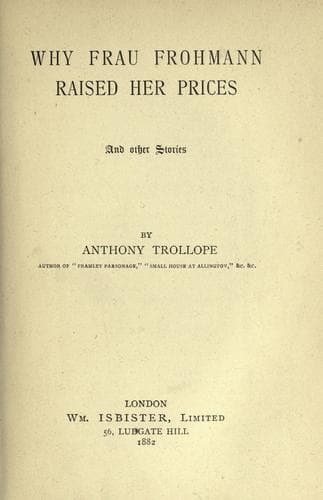
Why Frau Frohmann Raised Her Prices, and Other StoriesTrollope, Anthony
General
Why Frau Frohmann Raised Her Prices, and Other Stories
Trollope, Anthony
English fiction -- 19th century; Manners and customs -- Fiction; Short stories, English
“He is a great favourite with Sir Walter.”
“That is so good of Sir Walter.”
“And we are quite pleased to have him among our young people.” That was
all, but it was quite sufficient to tell Mrs. Rossiter that John might
have Georgiana Wanless for the asking, and that Lady Wanless expected
him to ask. Then the parting was much more affectionate than it had ever
been before, and there was a squeezing of the hand and a nodding of the
head which meant a great deal.
Alice held her tongue, and did her work and attempted to be cheery
through it all. Again and again she asked herself,--what did it matter?
Even though she were unhappy, even though she felt a keen, palpable,
perpetual aching at her heart, what would it matter so long as she
could go about and do her business? Some people in this world had to be
unhappy;--perhaps most people. And this was a sorrow which, though it
might not wear off, would by wearing become dull enough to be bearable.
She distressed herself in that there was any sorrow. Providence had
given to her a certain condition of life to which many charms were
attached. She thoroughly loved the people about her,--her father, her
little brothers and sisters, even her overworn and somewhat idle
stepmother. She was a queen in the house, a queen among her busy toils;
and she liked being a queen, and liked being busy. No one ever scolded
her or crossed her or contradicted her. She had the essential
satisfaction of the consciousness of usefulness. Why should not that
suffice to her? She despised herself because there was a hole in her
heart,--because she felt herself to shrink all over when the name of
Georgiana Wanless was mentioned in her hearing. Yet she would mention
the name herself, and speak with something akin to admiration of the
Wanless family. And she would say how well it was that men should strive
to rise in the world, and how that the world progressed through such
individual efforts. But she would not mention the name of John Rossiter,
nor would she endure that it should be mentioned in her hearing with any
special reference to herself.
Mrs. Dugdale, though she was overworn and idle,--a warped and almost
useless piece of furniture, made, as was said before, of bad
timber,--yet saw more of this than anyone else, and was indignant. To
lose Alice, to have no one to let down those tucks and take up those
stitches, would be to her the loss of all her comforts. But, though she
was feckless, she was true-hearted, and she knew that Alice was being
wronged. It was Alice that had a right to the hero, and not that
stuck-up young woman at Brook Park. It was thus she spoke of the affair
to the doctor, and after awhile found herself unable to be silent on the
subject to Alice herself. “If what they say does take place I shall
think worse of John Rossiter than I ever did of any man I ever knew.”
This she said in the presence both of her husband and her step-daughter.
Public-domain text, read in full here on John Shaqi.
Reviews
Reviews
No reviews yet
Be the first to share your thoughts on this work.
Elsewhere in the archive
Join the Discussion
Join the discussion
Sign in to leave a comment or review.
Sign InorCreate an account