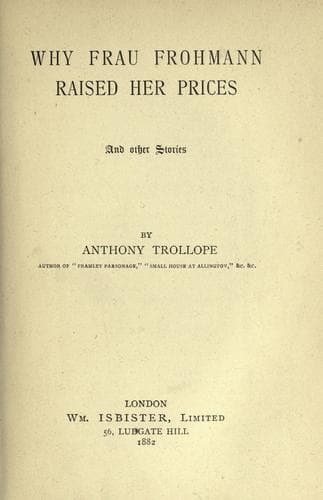
Why Frau Frohmann Raised Her Prices, and Other StoriesTrollope, Anthony
General
Why Frau Frohmann Raised Her Prices, and Other Stories
Trollope, Anthony
English fiction -- 19th century; Manners and customs -- Fiction; Short stories, English
The Major was fond of shooting, and would have been glad to accept the
offer; but it was out of the question that he should allow himself to be
taken in at Cobble Hall under a false pretext. And was it not incumbent
on him to make this young man understand that he had no pretensions
whatever to the hand of the second Miss Wanless? “You are very good,”
said he.
“We should be delighted,” said young Cobble.
“But I fear there is a mistake. I can’t say anything more about it now
because it doesn’t do to name people;--but there is a mistake. Only for
that I should have been delighted. Good-bye.” Then he took his
departure, leaving young Cobble in a state of mystified suspense.
The day lingered on to a great length. The archery and the lawn-tennis
were continued till late after the so-called lunch, and towards the
evening a few couples stood up to dance. It was evident to the Major
that Burmeston and Edith were thoroughly comfortable together. Gertrude
amused herself well, and even Maria was contented, though the curate as
a matter of course was not there. Sophia with her legitimate lover was
as happy as the day and evening were long. But there came a frown upon
Georgiana’s brow, and when at last the Major, as though forced by
destiny, asked her to dance, she refused. It had seemed to her a matter
of course that he should ask her, and at last he did;--but she refused.
The evening with him was very long, and just as he thought that he would
escape to bed, and was meditating how early he would be off on the
morrow, Lady Wanless took possession of him and carried him off alone
into one of the desolate chambers. “Is she very tired?” asked the
anxious mother.
“Is who tired?” The Major at that moment would have given twenty guineas
to have been in his lodgings near St. James’s Street.
“My poor girl,” said Lady Wanless, assuming a look of great solicitude.
It was vain for him to pretend not to know who was the “she” intended.
“Oh, ah, yes; Miss Wanless.”
“Georgiana.”
“I think she is tired. She was shooting a great deal. Then there was a
quadrille;--but she didn’t dance. There has been a great deal to tire
young ladies.”
“You shouldn’t have let her do so much.”
How was he to get out of it? What was he to say? If a man is clearly
asked his intentions he can say that he has not got any. That used to be
the old fashion when a gentleman was supposed to be dilatory in
declaring his purpose. But it gave the oscillating lover so easy an
escape! It was like the sudden jerk of the hand of the unpractised
fisherman: if the fish does not succumb at once it goes away down the
stream and is no more heard of. But from this new process there is no
mode of immediate escape. “I couldn’t prevent her because she is nothing
to me.” That would have been the straightforward answer;--but one most
difficult to make. “I hope she will be none the worse to-morrow
morning,” said the Major.
Public-domain text, read in full here on John Shaqi.
Reviews
Reviews
No reviews yet
Be the first to share your thoughts on this work.
Elsewhere in the archive
Join the Discussion
Join the discussion
Sign in to leave a comment or review.
Sign InorCreate an account