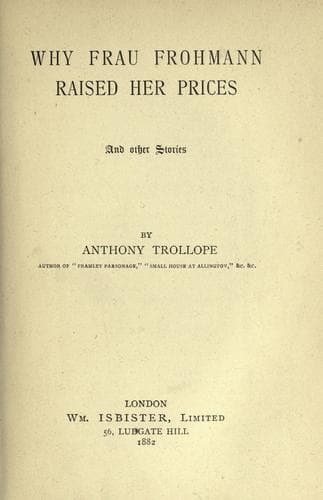
Why Frau Frohmann Raised Her Prices, and Other StoriesTrollope, Anthony
General
Why Frau Frohmann Raised Her Prices, and Other Stories
Trollope, Anthony
English fiction -- 19th century; Manners and customs -- Fiction; Short stories, English
“JOHN ROSSITER.”
The letter, when it was written, was, to himself, very unsatisfactory.
It was full of ambiguous words and namby-pamby phraseology which
disgusted him. But he did not know how to alter it for the better. It is
hard to say an uncivil thing civilly without ambiguous namby-pamby
language. He could not bring it out in straightforward stout English:
“You want me to marry your daughter, but I won’t do anything of the
kind.” So the letter was sent. The conduct of which he was really
ashamed did not regard Miss Wanless, but Alice Dugdale.
At last, very slowly, he took himself up to the doctor’s house. He
hardly knew what it was that he meant to say when he found himself
there, but he was sure that he did not mean to make an offer. Even had
other things suited, there would have been something distasteful to him
in doing this so quickly after the affair of Miss Wanless. He was in no
frame now for making love; but yet it would be ungracious in him, he
thought, to leave Beetham without seeing his old friend. He found the
two ladies together, with the children still around them, sitting near a
window which opened down to the ground. Mrs. Dugdale had a novel in
hand, and, as usual, was leaning back in a rocking-chair. Alice had also
a book open on the table before her, but she was bending over a
sewing-machine. They had latterly divided the cares of the family
between them. Mrs. Dugdale had brought the children into the world, and
Alice had washed, clothed, and fed them when they were there. When the
Major entered the room, Alice’s mind was, of course, full of the
tidings she had heard from her father,--which tidings, however, had not
been communicated to Mrs. Dugdale.
Alice at first was very silent while Mrs. Dugdale asked as to the
festivities. “It has been the grandest thing anywhere about here for a
long time.”
“And, like other grand things, a great bore,” said the Major.
“I don’t suppose you found it so, Major Rossiter,” said the lady.
Then the conversation ran away into a description of what had been done
during the day. He wished to make it understood that there was no
permanent link binding him to Brook Park, but he hardly knew how to say
it without going beyond the lines of ordinary conversation. At last
there seemed to be an opening,--not exactly what he wished, but still an
opening. “Brook Park is not exactly the place,” said he, “at which I
should ever feel myself quite at home.” This was in answer to some
chance word which had fallen from Mrs. Dugdale.
“I am sorry for that,” said Alice. She would have given a guinea to
bring the word back after it had been spoken. But spoken words cannot be
brought back.
“Why sorry?” he asked, smiling.
“Because--Oh, because it is so likely that you may be there often.”
“I don’t know that at all.”
“You have become so intimate with them!” said Alice. “We are told in
Beetham that the party was got up all for your honour.”
Public-domain text, read in full here on John Shaqi.
Reviews
Reviews
No reviews yet
Be the first to share your thoughts on this work.
Elsewhere in the archive
Join the Discussion
Join the discussion
Sign in to leave a comment or review.
Sign InorCreate an account