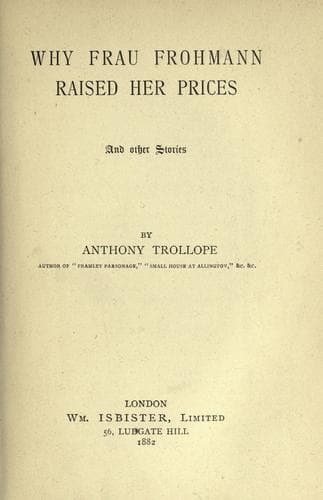
Why Frau Frohmann Raised Her Prices, and Other StoriesTrollope, Anthony
General
Why Frau Frohmann Raised Her Prices, and Other Stories
Trollope, Anthony
English fiction -- 19th century; Manners and customs -- Fiction; Short stories, English
“Not at all. He has said a great deal to her;--much more than he ought
to have done, if he meant nothing. But the truth is, young men nowadays
never know their own minds unless there is somebody to keep them up to
the mark. You must go and see him.”
“I!” said the afflicted father.
“Of course, my dear. A few judicious words in such a case may do so
much. I would not ask Walter to go,”--Walter was the eldest son, who was
with his regiment,--“because it might lead to quarrelling. I would not
have anything of that kind, if only for the dear girl’s sake. But what
you would say would be known to nobody; and it might have the desired
effect. Of course you will be very quiet,--and very serious also. Nobody
could do it better than you will. There can be no doubt that he has
trifled with the dear girl’s affections. Why else has he been with her
whenever he has been here? It was so visible on Wednesday that everybody
was congratulating me. Old Lady Deepbell asked whether the day was
fixed. I treated him quite as though it were settled. Young men do so
often get these sudden starts of doubt. Then, sometimes, just a word
afterwards will put it all right.” In this way the Baronet was made to
understand that he must go and see the Major.
He postponed the unwelcome task till his wife at last drove him out of
the house. “My dear,” she said, “will you let your child die
broken-hearted for want of a word?” When it was put to him in that way
he found himself obliged to go, though, to tell the truth, he could not
find any sign of heart-breaking sorrow about his child. He was not
allowed to speak to Georgiana herself, his wife telling him that the
poor child would be unable to bear it.
Sir Walter, when he was shown into the Major’s room, felt himself to be
very ill able to conduct the business in hand, and to the Major himself
the moment was one of considerable trouble. He had thought it possible
that he might receive an answer to his letter, a reply that might be
indignant, or piteous, admonitory, or simply abusive, as the case might
be,--one which might too probably require a further correspondence; but
it had never occurred to him that Sir Walter would come in person. But
here he was,--in the room,--by no means with that pretended air of
geniality with which he had last received the Major down at Brook Park.
The greeting, however, between the gentlemen was courteous if not
cordial, and then Sir Walter began his task. “We were quite surprised
you should have left us so early that morning.”
“I had told Lady Wanless.”
“Yes; I know. Nevertheless we were surprised. Now, Major Rossiter, what
do you mean to do about,--about,--about this young lady?” The Major sat
silent. He could not pretend to be ignorant what young lady was intended
after the letter which he had himself written to Lady Wanless. “This,
you know, is a very painful kind of thing, Major Rossiter.”
“Very painful indeed, Sir Walter.”
Public-domain text, read in full here on John Shaqi.
Reviews
Reviews
No reviews yet
Be the first to share your thoughts on this work.
Elsewhere in the archive
Join the Discussion
Join the discussion
Sign in to leave a comment or review.
Sign InorCreate an account