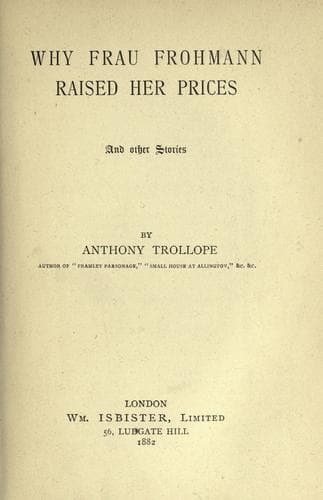
Why Frau Frohmann Raised Her Prices, and Other StoriesTrollope, Anthony
General
Why Frau Frohmann Raised Her Prices, and Other Stories
Trollope, Anthony
English fiction -- 19th century; Manners and customs -- Fiction; Short stories, English
But she took pride to herself as she walked alone that she had already
overcome the bitterness of the malady which, for a day or two, had been
so heavy that she had feared for herself that it would oppress her. For
a day or two after that farewell at the gate she had with a rigid
purpose tied herself to every duty,--even to the duty of looking
pleasant in her father’s eyes, of joining in the children’s games, of
sharing the gossip of her stepmother. But this she had done with an
agony that nearly crushed her. Now she had won her way through it, and
could see her path before her. She had not cured altogether that wound
in her heart; but she had assured herself that she could live on without
further interference from the wound.
CHAPTER IX.
LADY DEEPBELL.
Then by degrees it began to be rumoured about the country, and at last
through the lanes of Beetham itself, that the alliance between Major
Rossiter and Miss Georgiana Wanless was not quite a settled thing. Mr.
Burmeston had whispered in Slowbridge that there was a screw loose,
perhaps thinking that if another could escape, why not he also? Cobble,
who had no idea of escaping, declared his conviction that Major Rossiter
ought to be horsewhipped; but Lady Deepbell was the real town-crier who
carried the news far and wide. But all of them heard it before Alice,
and when others believed it Alice did not believe it,--or, indeed, care
to believe or not to believe.
Lady Deepbell filled a middle situation, half way between the
established superiority of Brook Park and the recognised humility of
Beetham. Her title went for something; but her husband had been only a
Civil Service Knight, who had deserved well of his country by a
meritorious longevity. She lived in a pretty little cottage half way
between Brook Park and Beetham, which was just large enough to enable
her to talk of her grounds. She loved Brook Park dearly, and all the
county people; but in her love for social intercourse generally she was
unable to eschew the more frequent gatherings of the village. She was
intimate not only with Mrs. Rossiter, but with the Tweeds and Dugdales
and Simkinses, and, while she could enjoy greatly the grandeur of the
Wanless aristocracy, so could she accommodate herself comfortably to the
cosy gossip of the Beethamites. It was she who first spread the report
in Beetham that Major Rossiter was,--as she called it,--“off.”
She first mentioned the matter to Mrs. Rossiter herself; but this she
did in a manner more subdued than usual. The “alliance” had been high,
and she was inclined to think that Mrs. Rossiter would be disappointed.
“We did think, Mrs. Rossiter, that these young people at Brook Park had
meant something the other day.”
Mrs. Rossiter did not stand in awe of Lady Deepbell, and was not pleased
at the allusion. “It would be much better if young people could be
allowed to arrange their own affairs without so much tattling about it,”
she said angrily.
Public-domain text, read in full here on John Shaqi.
Reviews
Reviews
No reviews yet
Be the first to share your thoughts on this work.
Elsewhere in the archive
Join the Discussion
Join the discussion
Sign in to leave a comment or review.
Sign InorCreate an account