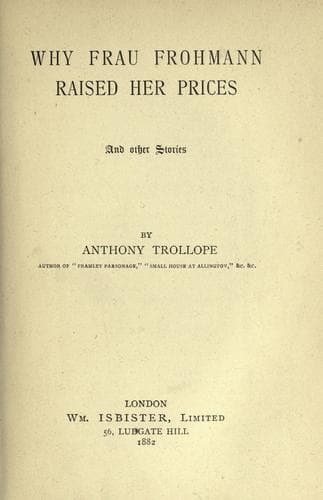
Why Frau Frohmann Raised Her Prices, and Other StoriesTrollope, Anthony
General
Why Frau Frohmann Raised Her Prices, and Other Stories
Trollope, Anthony
English fiction -- 19th century; Manners and customs -- Fiction; Short stories, English
“I told him, when he asked, that I should never marry Mr. Morrison.”
Then it was--in that very moment--that Mrs. Miles in truth suspected the
blow that was to fall upon her; and in that same moment she resolved
that, let the pain be what it might to any or all of them, she would do
her duty by her family.
“Yes,” she said to herself, as she sat alone in the unadorned,
unattractive sanctity of her own bedroom, “I will do my duty at any rate
now.” With deep remorse she acknowledged to herself that she had been
remiss. For a moment her anger was very bitter. She had warmed a reptile
in her bosom. The very words came to her thoughts, though they were not
pronounced. But the words were at once rejected. The girl had been no
reptile. The girl had been true. The girl had been as sweet a girl as
had ever brightened the hearth of an old woman. She acknowledged so much
to herself even in this moment of her agony. But not the less would she
do her duty by the family of the Launays. Let the girl do what she
might, she must be sent away--got rid of--sacrificed in any way rather
than that Philip should be allowed to make himself a fool.
When for a couple of days she had turned it all in her mind she did not
believe that there was as yet any understanding between the girl and
Philip. But still she was sure that the danger existed. Not only had the
girl refused her destined husband--just such a man as such a girl as
Bessy ought to have loved--but she had communicated her purpose in that
respect to Philip. There had been more of confidence between them than
between her and the girl. How could they two have talked on such a
subject unless there had been between them something of stricter, closer
friendship even than that of brother and sister? There had been
something of a conspiracy between them against her--her who at Launay
was held to be omnipotent, against her who had in her hands all the
income, all the power, all the ownership--the mother of one of them, and
the protectress and only friend of the other! She would do her duty, let
Bessy be ever so sweet. The girl must be made to marry Mr. Morrison--or
must be made to go.
But whither should she go, and if that “whither” should be found, how
should Philip be prevented from following her? Mrs. Miles, in her agony,
conceived an idea that it would be easier to deal with the girl herself
than with Philip. A woman, if she thinks it to be a duty, will more
readily sacrifice herself in the performance of it than will a man. So
at least thought Mrs. Miles, judging from her own feelings; and Bessy
was very good, very affectionate, very grateful, had always been
obedient. If possible she should be driven into the arms of Mr.
Morrison. Should she stand firm against such efforts as could be made
in that direction, then an appeal should be made to herself. After all
that had been done for her, would she ruin the family of the Launays for
the mere whim of her own heart?
Public-domain text, read in full here on John Shaqi.
Reviews
Reviews
No reviews yet
Be the first to share your thoughts on this work.
Elsewhere in the archive
Join the Discussion
Join the discussion
Sign in to leave a comment or review.
Sign InorCreate an account