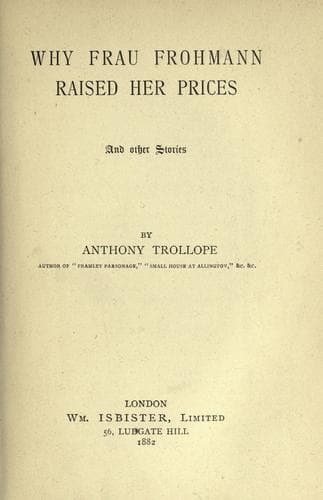
Why Frau Frohmann Raised Her Prices, and Other StoriesTrollope, Anthony
General
Why Frau Frohmann Raised Her Prices, and Other Stories
Trollope, Anthony
English fiction -- 19th century; Manners and customs -- Fiction; Short stories, English
There was a potency about Mrs. Miles which enabled her to have her will
carried out, although she was lying ill in bed,--to have her will
carried out as far as the immediate severance of the lovers was
concerned. When the command had been brought by the mouth of a servant,
Bessy determined that she would not see Philip again before he went. She
understood that she was bound by her position, bound by gratitude, bound
by a sense of propriety, to so much obedience as that. No earthly
authority could be sufficient to make her abandon her troth. In that she
could not allow even her aunt to sway her,--her aunt though she were
sick and suffering, even though she were dying! Both her love and her
vow were sacred to her. But obedience at the moment she did owe, and she
kept her room. Philip came to the door, but she sat mute and would not
speak to him. Mrs. Knowl, when she brought her some food, asked her
whether she intended to obey the order. “Your aunt wants a promise from
you, Miss Bessy?”
“I am sure my aunt knows that I shall obey her,” said Bessy.
On the following morning Philip left the house. He sent a message to his
mother, asking whether she would see him; but she refused. “I think you
had better not disturb her, Mr. Philip,” said Mrs. Knowl. Then he went,
and as the waggonette took him away from the door, Bessy sat and
listened to the sound of the wheels on the gravel.
All that day and all the next passed on and she was not allowed to see
her aunt. Mrs. Knowl repeated that she could not take upon herself to
say that Madam was better. No doubt the worry of the last day or two
had been a great trouble to her. Mrs. Knowl grew much in self-importance
at the time, and felt that she was overtopping Miss Bessy in the affairs
of Launay.
It was no less true than singular that all the sympathies of the place
should be on the side of the old woman. Her illness probably had
something to do with it. And then she had been so autocratic, all Launay
and Budcombe had been so accustomed to bow down to her, that rebellion
on the part of anyone seemed to be shocking. And who was Bessy Pryor
that she should dare to think of marrying the heir? Who, even, was the
supposed heir that he should dare to think of marrying anyone in
opposition to the actual owner of the acres? Heir though he was called,
he was not necessarily the heir. She might do as she pleased with all
Launay and all Budcombe, and there were those who thought that if Philip
was still obstinate she would leave everything to her elder son. She did
not love her elder son. In these days she never saw him. He was a gay
man of the world, who had never been dutiful to her. But he might take
the name of Launay, and the family would be perpetuated as well that way
as the other. Philip was very foolish. And as for Bessy; Bessy was worse
than foolish. That was the verdict of the place generally.
Public-domain text, read in full here on John Shaqi.
Reviews
Reviews
No reviews yet
Be the first to share your thoughts on this work.
Elsewhere in the archive
Join the Discussion
Join the discussion
Sign in to leave a comment or review.
Sign InorCreate an account