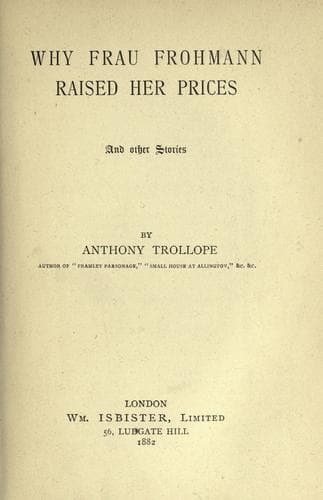
Why Frau Frohmann Raised Her Prices, and Other StoriesTrollope, Anthony
General
Why Frau Frohmann Raised Her Prices, and Other Stories
Trollope, Anthony
English fiction -- 19th century; Manners and customs -- Fiction; Short stories, English
She was in truth very miserable. It was not only because of her love,
from which she had from the first been aware that misery must
come,--undoubted misery, if not misery that would last through her whole
life. But now there was added to this the sorrow of absolute banishment
from her aunt. Mrs. Miles would not see her again before she started.
Bessy was well aware of all that she owed to the mistress of Launay;
and, being intelligent in the reading of character, was aware also that
through many years she had succeeded in obtaining from the old woman
more than the intended performance of an undertaken duty. She had forced
the old woman to love her, and was aware that by means of that love the
old woman’s life had been brightened. She had not only received, but had
conferred kindness,--and it is by conferring kindness that love is
created. It was an agony to her that she should be compelled to leave
this dearest friend, who was still sick and infirm, without seeing her.
But Mrs. Miles was inexorable. These four words written on a scrap of
paper were brought to her on that morning:--“Pray, pray, see me!” She
was still inexorable. There had been long pencil-written notes between
them on the previous day. If Bessy would pledge herself to give up her
lover all might yet be changed. The old woman at Avranches should be
compensated for her disappointment. Bessy should be restored to all her
privileges at Launay. “You shall be my own, own child,” said Mrs. Miles.
She condescended even to promise that not a word more should be said
about Mr. Morrison. But Bessy also could be inexorable. “I cannot say
that I will give him up,” she wrote. Thus it came to pass that she had
to get into the waggonette without seeing her old friend. Mrs. Knowl
went with her, having received instructions to wait upon Miss Bessy all
the way to Avranches. Mrs. Knowl felt that she was sent as a guard
against the lover. Mrs. Miles had known Bessy too well to have fear of
that kind, and had sent Mrs. Knowl as general guardian against the wild
beasts which are supposed to be roaming about the world in quest of
unprotected young females.
In the distribution of her anger Mrs. Miles had for the moment been very
severe towards Philip as to pecuniary matters. He had chosen to be
rebellious, and therefore he was not only turned out of the house, but
told that he must live on an uncomfortably small income. But to Bessy
Mrs. Miles was liberal. She had astounded Miss Gregory by the nobility
of the terms she had proposed, and on the evening before the journey had
sent ten five-pound notes in a blank envelope to Bessy. Then in a
subsequent note she had said that a similar sum would be paid to her
every half-year. In none of these notes was there any expression of
endearment. To none of them was there even a signature. But they all
conveyed evidence of the amount of thought which Mrs. Miles was giving
to Bessy and her affairs.
Public-domain text, read in full here on John Shaqi.
Reviews
Reviews
No reviews yet
Be the first to share your thoughts on this work.
Elsewhere in the archive
Join the Discussion
Join the discussion
Sign in to leave a comment or review.
Sign InorCreate an account