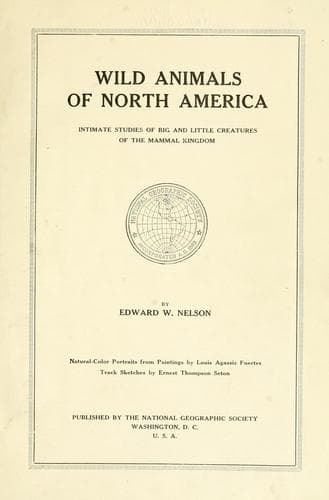
Wild Animals of North America: Intimate Studies of Big and Little Creatures of the Mammal KingdomNelson, Edward William
Science
Wild Animals of North America: Intimate Studies of Big and Little Creatures of the Mammal Kingdom
Nelson, Edward William
Mammals -- North America
With the exception of the moles no other extensive group of American
land mammals is so highly specialized for a peculiarly restricted mode
of life as the pocket gophers. They form a strongly marked family, the
Geomyidæ, which includes various genera and many species, all very
similar in external form, but varying from the size of a large mouse to
a massively formed animal equalling a large house rat in weight.
Without exception they are powerfully built for their size, the head
and front half of the body being extraordinarily muscled to meet the
demands of their mode of life. The broad blunt head is joined almost
directly on the body. The eyes are small and have the restricted vision
to be expected from animals living underground. The ears are reduced
to little fleshy rims about the openings, and the short naked tail is
provided with nerves, which render it useful as an organ of touch.
The front teeth are broad, cutting chisels, and on each side of the
mouth is a large pocket in the skin used for gathering and carrying
food. On the front feet are long claws, which, when not being used to
dig or handle earth, are doubled under, against the soles of the feet,
so that the gopher walks on the back of them much as the ant-eater
walks on its folded claws.
Peculiar to North America, pocket gophers occupy a great area extending
from Illinois, Florida, and the Gulf of Mexico to the Pacific coast,
and from the plains of the Saskatchewan, in Canada, southward to
Panama. Their vertical range within these limits extends from sea level
to timber-line, at above 13,000 feet on some of the high volcanoes of
Mexico. The family attains its greatest development in that wonderful
region of plains and volcanoes lying about the southern end of the
Mexican table-land.
In the United States these animals are best known as “gophers,” but
in the range they occupy in the Southeastern States they are called
“salamanders” and in Mexico are widely known as “tuzas.” As a rule they
frequent treeless areas, but are found also in many types of forests
from among the palms and other trees of the tropical lowlands to the
oaks, pines, and firs on the mountain sides.
All members of the family live wholly underground, in many-branched
horizontal tunnels, which they are continually extending in winding and
erratic courses about their haunts. The tunnels are from two to about
five inches in diameter, according to the size of the animal, and while
usually less than six inches below the surface, the approaches to the
nest and storage chambers sometimes drop abruptly two or three feet
below the regular working tunnels to the level of the living quarters.
At intervals along the tunnels short side branches are used as sanitary
conveniences, thus enabling the occupant to keep the main passageways
in a habitable condition.
Public-domain text, read in full here on John Shaqi.
Reviews
Reviews
No reviews yet
Be the first to share your thoughts on this work.
Elsewhere in the archive
Join the Discussion
Join the discussion
Sign in to leave a comment or review.
Sign InorCreate an account