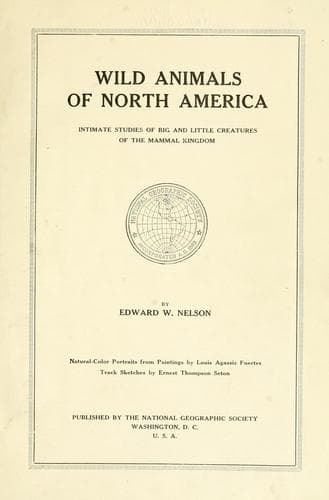
Wild Animals of North America: Intimate Studies of Big and Little Creatures of the Mammal KingdomNelson, Edward William
Science
Wild Animals of North America: Intimate Studies of Big and Little Creatures of the Mammal Kingdom
Nelson, Edward William
Mammals -- North America
Soon after they appear in spring they mate and the single litter of
the year, containing from five to thirteen young, is born the last of
May or early in June. The young are in an extremely undeveloped state
at birth, being blind, hairless, and with the ears scarcely showing.
They develop slowly and remain with the mother until toward fall, when,
nearly grown, they scatter to care for themselves.
The striped ground squirrels are among the most carnivorous of rodents.
Although they devote much time to gathering grain, seeds of various
kinds, and even acorns and other nuts, which may be eaten on the spot
or carried in their cheek pouches to their underground storage rooms,
in addition they are known to eat insects and flesh whenever occasion
offers. In fact, during seasons when such insect food as grasshoppers,
caterpillars, and grubs is plentiful, these ground squirrels frequently
feed mainly upon it. They are known to kill and devour mice and young
birds, and when confined in a cage will sometimes kill and partly
devour their own kind. When caught they fight fiercely, biting and
struggling to escape. In captivity they show little of the gentleness
and intelligence which are such pleasing characteristics of chipmunks
and true squirrels.
=THE CALIFORNIA GROUND SQUIRREL= (=Citellus beecheyi= and its
relatives)
(_For illustration, see page 539_)
Owing to its habits, the California ground squirrel is known locally as
the digger-, rock-, or ground-squirrel. Its prominent ears, bushy tail,
color, and form give it the general appearance of a heavy-bodied gray
tree squirrel, but in reality it is a true, spermophile and close kin
to the marmots.
[Illustration: GOLDEN CHIPMUNK
_Callospermophilus lateralis chrysodeirus_]
[Illustration: EASTERN CHIPMUNK
_Tamias striatus_]
Spermophiles are nearly circumpolar in distribution, ranging through
northern lands from central Europe across Bering Strait to the Great
Lakes in North America. Many species exist in North America, varying
greatly in form, size, and color. They occur mainly in the western
part of the continent from the Arctic coast of Alaska to the southern
end of the Mexican table-land. Some species are represented by enormous
numbers and do great injury to cultivated crops. Among the larger and
best known of the injurious species, the California ground squirrel,
with its several geographic races, occupies most of the Pacific coast
region from Oregon to Lower California. It has a broad vertical
distribution, extending from the seashore to about 10,000 feet altitude
on the western slope of the Sierra Nevada in California, and thrives
under contrasting climatic conditions, as the humid northwest coast
region and the most arid deserts of Lower California.
[Illustration: OREGON CHIPMUNK
_Eutamias townsendi_]
[Illustration: PAINTED CHIPMUNK
_Eutamias minimus pictus_]
Public-domain text, read in full here on John Shaqi.
Reviews
Reviews
No reviews yet
Be the first to share your thoughts on this work.
Elsewhere in the archive
Join the Discussion
Join the discussion
Sign in to leave a comment or review.
Sign InorCreate an account