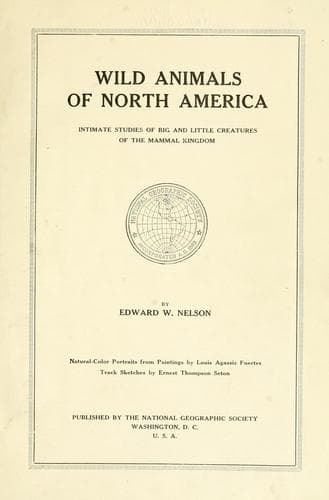
Wild Animals of North America: Intimate Studies of Big and Little Creatures of the Mammal KingdomNelson, Edward William
Science
Wild Animals of North America: Intimate Studies of Big and Little Creatures of the Mammal Kingdom
Nelson, Edward William
Mammals -- North America
Their food is extremely varied and includes whatever nuts grow in their
haunts, as beechnuts, pecans, acorns, and others, with many kinds of
seeds, including corn gathered in the field, and buds, and fruits of
many kinds. They also eat many insects, larvæ, birds and their eggs,
and meat. Taking advantage of their known liking for bird flesh, they
may frequently be caught by concealing a trap on top of a log in the
woods and scattering bird feathers over and about it. Trappers for
marten and other forest fur-bearers are much annoyed in winter by the
persistence with which the flying squirrels search out their traps
and become caught in them, thus forestalling a more valued capture.
Trappers in Montana who run long lines of traps for marten through
the mountain forests capture hundreds of these squirrels in a single
season.
Flying squirrels have several notes, one of which is an ordinary
_chuck, chuck_, much like that of other squirrels. They also utter
sharp squeaks and squeals when angry or much alarmed, and a clear
musical chirping note, birdlike in character, which is frequently
repeated for several minutes in succession and is undoubtedly a song.
[Illustration: THE TRAIL OF THE MUSKRAT
The usual gait of the muskrat on land is a slow walk. The tail mark is
always very strongly shown (see pages 513 and 526).]
These beautiful little animals become the most delightful of pets,
as they are notable for extraordinary playfulness and a readiness to
accept man as a friend. Many interesting accounts have been published
concerning the affectionate attachment they form for their human hosts
and the amusing and tireless activity they show at night. By day they
remain sound asleep, rolled up in a furry ball in some dark corner.
They are known to have a litter of from two to six young in April, and
young are born at various times throughout the summer, but it is still
unsettled whether there is more than one litter a year. The mother is
devoted to the young, and if driven from them will keep close by at the
risk of her life, showing much anxiety and readiness to do what she can
to protect them. One instance well illustrates this maternal care. From
a nest in a hollow stub the helpless young were taken and placed on the
ground at its base, while the despoiler of the home stood by to observe
the result. The mother soon returned and not finding her family in the
nest promptly located them on the ground. Quickly descending, she took
one in her mouth, carried it to the top of the stub and, launching
into the air, sailed to a tree thirty feet away, up which she carried
her baby and placed it safely in a knot-hole. The trip was quickly
repeated until the family was reunited in its new location.
[Illustration: THE TRACKS OF A GRASSHOPPER MOUSE
Public-domain text, read in full here on John Shaqi.
Reviews
Reviews
No reviews yet
Be the first to share your thoughts on this work.
Elsewhere in the archive
Join the Discussion
Join the discussion
Sign in to leave a comment or review.
Sign InorCreate an account