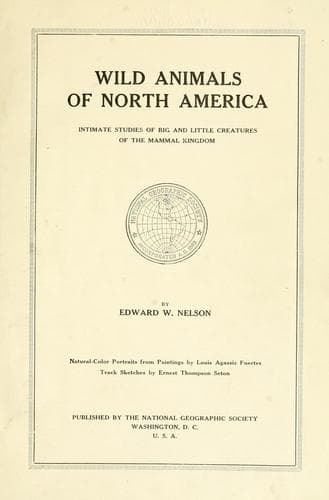
Wild Animals of North America: Intimate Studies of Big and Little Creatures of the Mammal KingdomNelson, Edward William
Science
Wild Animals of North America: Intimate Studies of Big and Little Creatures of the Mammal Kingdom
Nelson, Edward William
Mammals -- North America
Once when hunting on the open plain near the southern end of the
Mexican table-land, I saw at some distance what appeared to be a brown
ball rolling about on the ground. This was soon determined to be a
weasel fastened to one of the large and powerful pocket gophers of
that region. The weasel had its teeth set in the back of the neck of
the gopher, while the latter was blindly trying to tear itself loose.
I fired an ineffectual shot at the weasel and it vanished like a flash
in the open tunnel of the gopher. As I drew near, the gopher, still in
fighting mood, faced me with bared teeth. Later, when I removed its
skin, I found that the weasel had torn loose the attachment of the
heavy neck muscles to the back of the skull until only a thin layer
remained to protect the spinal column. This had been accomplished
without breaking the thin, but extremely tough, skin of the gopher.
When a weasel is attacking an animal which resists, like a large ground
squirrel, it raises its head and sways its long neck back and forth,
its eyes glittering with excitement as it watches for an opening to
spring forward and seize its prey. Its attack is always aimed at a
vital point, commonly the brain, the back of the neck, or the jugular
vein on the side.
Weasels dig their own burrows under the shelter of slide rock, ledges,
stone walls, stumps, and outbuildings, or they occupy hollow trees and
the deserted burrows of other animals. In nests thus safely located
they have one litter containing an average of from four to six, but
sometimes numbering up to twelve, young a year. They are born at any
time from April to June, according to the latitude. The number of
young in a litter is enough to render weasels very abundant, but this
is rarely the case, and raises the question as to the influence which
holds their number in check.
They are both nocturnal and diurnal, apparently in almost equal degree,
since they are frequently observed hunting in the middle of the
day, while their nocturnal raids on poultry houses testify to their
activities at night. When hunting they appear like sinister shadows and
are persistent in pursuit. The young commonly remain with the female
until nearly or quite grown and follow her closely on hunting-trips. It
is interesting to see a pack of these deadly carnivores working, the
mother leading and the young skirmishing on all sides, now spreading
out, now closing in, like a pack of miniature hounds. On these family
hunting parties, however, they usually keep close to the rocks, logs,
brush, or other cover.
Themselves subject to the law of fang and claw, weasels are killed and
eaten by wolves, coyotes, foxes, and various birds of prey. Their very
lack of fear perhaps in many cases leads to their destruction.
These representatives of the primitive woodland life continue to occupy
practically all of their original range. They visit farms in all parts
of the country and I have seen them near the outskirts of Washington.
Public-domain text, read in full here on John Shaqi.
Reviews
Reviews
No reviews yet
Be the first to share your thoughts on this work.
Elsewhere in the archive
Join the Discussion
Join the discussion
Sign in to leave a comment or review.
Sign InorCreate an account