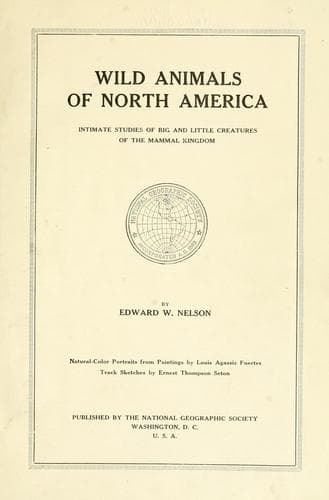
Wild Animals of North America: Intimate Studies of Big and Little Creatures of the Mammal KingdomNelson, Edward William
Science
Wild Animals of North America: Intimate Studies of Big and Little Creatures of the Mammal Kingdom
Nelson, Edward William
Mammals -- North America
The species are taken up in groups, in so far as this can be done
safely. Each biography, of which there are 119, is, as a rule, a
composite applying to a number of near-related forms, thus simplifying
matters of presentation, and avoiding repetition. A marked feature of
the book is the degree of concentration attained; there is no trace
of padding, and no room for baseless speculation, sentimentalizing or
humanizing, such as characterize many current “nature” books. At the
same time the style is animated and thoroughly entertaining, a gift of
composition which Nelson has exercised in many preceding contributions.
Here is an instance, unfortunately a rare one, in which a man who
really knows the field has put out a popular book on a natural history
subject.
Many are the portrayals which are evidently based on Nelson’s own
personal field knowledge, some of them involving facts here for the
first time made known to science. His account of the behavior of
kangaroo rats in Lower California is particularly apt in illustration
of the above statement.
During several nights I passed hours watching at close range the
habits of these curious animals. As I sat quietly on a mess box in
their midst ... [they] would forage all about with swift gliding
movements, repeatedly running across my bare feet. Any sudden
movement startled them and all would dart away for a moment, but
quickly return.... They were so intent on the food [grains of rice
put out for them] that at times I had no difficulty in reaching
slowly down and closing my hand over their backs. I did this
dozens of times, and after a slight struggle they always became
quiet until again placed on the ground, when they at once renewed
their search for food as though no interruption had occurred....
While occupied in this rivalry for food they became surprisingly
pugnacious. If one was working at the rice pile and another rat or
a pocket mouse approached, it immediately darted at the intruder
and drove it away. The mode of attack was to rush at an intruder
and, leaping upon its back, give a vigorous downward kick with its
strong hind feet.... Sometimes an intruder, bolder than the others,
would run only two or three yards and then suddenly turn and face
the pursuer, sitting up on its hind feet like a little kangaroo.
The pursuer at once assumed the same nearly upright position,
with its fore feet close to its breast. Both would then begin to
hop about watching for an opening. Suddenly one would leap at the
other, striking with its hind feet, ... [producing] a distinct
little thump and the victim rolled over on the ground. After
receiving two or three kicks the weaker of the combatants would run
away. The thump made by the kick when they were fighting solved the
mystery which had covered this sound heard repeatedly during my
nights at this camp.
Public-domain text, read in full here on John Shaqi.
Reviews
Reviews
No reviews yet
Be the first to share your thoughts on this work.
Elsewhere in the archive
Join the Discussion
Join the discussion
Sign in to leave a comment or review.
Sign InorCreate an account