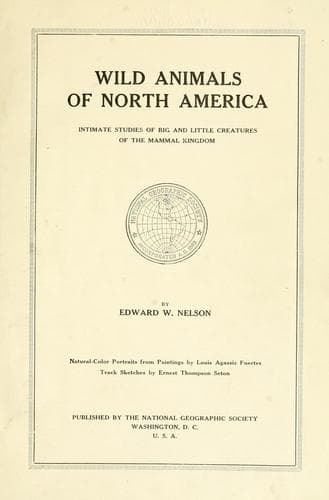
Wild Animals of North America: Intimate Studies of Big and Little Creatures of the Mammal KingdomNelson, Edward William
Science
Wild Animals of North America: Intimate Studies of Big and Little Creatures of the Mammal Kingdom
Nelson, Edward William
Mammals -- North America
The walruses, or “sea horses” of the old navigators, are the strangest
and most grotesque of all sea mammals. Their large, rugged heads, armed
with two long ivory tusks, and their huge swollen bodies, covered with
hairless, wrinkled, and warty skin, gives them a formidable appearance
unlike that of any other mammal. They are much larger than most seals,
the old males weighing from 2,000 to 3,000 pounds and the females about
two-thirds as much.
These strange beasts are confined to the Arctic Ocean and the adjacent
coasts and islands and are most numerous about the borders of the pack
ice. Two species are known, one belonging to the Greenland seas, while
the other, the Pacific walrus, is limited to Bering Sea and the Arctic
basin beyond Bering Straits.
The Pacific walruses migrate southward through Bering Straits with
the pack ice in fall and spend the winter in Bering Sea and along
the adjacent coast of eastern Asia. In spring they return northward
through the straits and pass the breeding season about the ice pack,
where they congregate in great herds. One night in July, 1881, the U.
S. steamer _Corwin_ cruised for hours along the edge of the ice pack
off the Arctic coast of Alaska and we saw an almost unbroken line of
walruses hauled out on the ice, forming an extended herd which must
have contained tens of thousands.
Walruses were formerly very abundant in Bering Sea, especially about
the Fur Seal Islands and along the coast north of the Peninsula
of Alaska, but few now survive there. Owing to the value of their
thick skins, blubber, and ivory tusks, they have been subjected to
remorseless pursuit since the early Russian occupation of their
territory and have, as a result, become extinct in parts of their
former range and the species is now in serious danger of extermination.
Like many of the seals, walruses have a strong social instinct, and
although usually seen in herds they are not polygamous. They feed
mainly on clams or other shellfish, which they gather on the bottom
of the shallow sea. On shore or on the ice they move slowly and with
much difficulty, but in the water they are thoroughly at home and good
swimmers. When hauled out on land or ice, they usually lie in groups
one against the other. They are stupid beasts and hunters have no
difficulty in killing them with rifles at close range.
Public-domain text, read in full here on John Shaqi.
Reviews
Reviews
No reviews yet
Be the first to share your thoughts on this work.
Join the Discussion
Join the discussion
Sign in to leave a comment or review.
Sign InorCreate an account