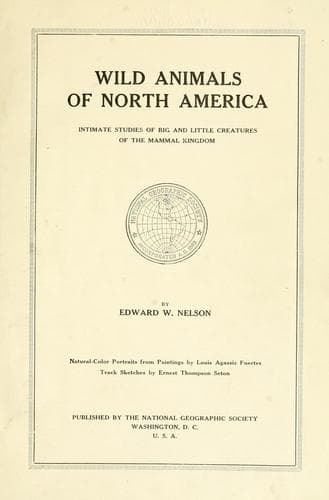
Wild Animals of North America: Intimate Studies of Big and Little Creatures of the Mammal KingdomNelson, Edward William
Science
Wild Animals of North America: Intimate Studies of Big and Little Creatures of the Mammal Kingdom
Nelson, Edward William
Mammals -- North America
Walruses have a strongly developed maternal instinct and show great
devotion and disregard of their own safety in defending the young. The
Eskimos at Cape Vancouver, Bering Sea, hunt them in frail skin-covered
kyaks, using ivory- or bone-pointed spears and seal-skin floats.
Several hunters told me of exciting and dangerous encounters they had
experienced with mother walruses. If the young are attacked, or even
approached, the mother does not hesitate to charge furiously. The
hunters confess that on such occasions there is no option but to paddle
for their lives. Occasionally an old walrus is unusually vindictive
and, after forcing a hunter to take refuge on the ice, will remain
patrolling the vicinity for a long time, roaring and menacing the
object of her anger.
When boats approach the edge of the ice where walruses are hauled
up, the animals plunge into the sea in a panic and rise all about
the intruders, bellowing and rushing about, rearing their huge heads
and gleaming white tusks high out of water in an alarming manner. As
a rule, however, they are timid and seek only to escape, although
occasionally, in their excitement, one has been known to attack a boat
and by a single blow of its tusks to do serious damage and endanger the
crew.
ALASKA FUR SEAL (Callorhinus alascanus)
Several species of fur seals are known, all of them limited to the
southern oceans or the coasts and islands of the North Pacific. All
are strongly gregarious and formerly sought their island breeding
grounds in vast numbers. At one period, soon after the purchase of
Alaska, it was estimated that several million fur seals were on the
Pribilof Islands in one season. During the height of their abundance
the southern fur seals were equally numerous.
The value of their skins and the facility with which these animals may
be slaughtered have resulted in the practical extermination of all but
those which breed under governmental protection on the Russian islands
off the coast of Kamchatka and on the Pribilof Islands in Alaska. Owing
mainly to wasteful pelagic sealing prior to the recent international
treaty, the numbers on both these groups of islands were much reduced.
The Alaska fur seal is a migratory species, wintering down the Pacific
coast as far as northern California. The migrations of these seals
are of remarkable interest. In spring they leave the northwest coast
and many of them travel steadily across more than two thousand miles
of the North Pacific. For days at a time they swim through a roaring
gale-swept sea, under dense, low-hanging clouds, and with unerring
certainty strike certain passages in the Aleutian Islands, through
which they press to their breeding grounds, more than 100 miles beyond,
on the small, fog-hidden Pribilof Islands.
Public-domain text, read in full here on John Shaqi.
Reviews
Reviews
No reviews yet
Be the first to share your thoughts on this work.
Join the Discussion
Join the discussion
Sign in to leave a comment or review.
Sign InorCreate an account