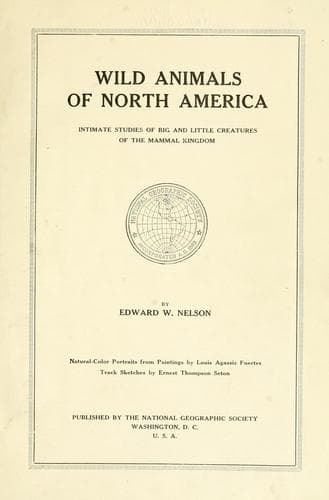
Wild Animals of North America: Intimate Studies of Big and Little Creatures of the Mammal KingdomNelson, Edward William
Science
Wild Animals of North America: Intimate Studies of Big and Little Creatures of the Mammal Kingdom
Nelson, Edward William
Mammals -- North America
Fur seals are extremely polygamous and the old males, which weigh from
400 to 500 pounds, “haul up” first on the breeding beaches. Each bull
holds a certain area, and as the females, only one-fifth his size, come
ashore they are appropriated by the nearest bulls until each “beach
master” gathers a harem, sometimes containing more than 100 members.
Here the young are born, and after the mating season the seals, which
have remained ashore without food from four to six weeks, return to the
water. The mothers go and come, and each is able to find her young with
certainty among thousands of apparently identical woolly black “pups.”
From the ages of one to four years fur seals are extremely playful.
They are marvelous swimmers and frolic about in pursuit of one another,
now diving deep and then, one after the other, suddenly leaping high
above the surface in graceful curves, like porpoises. Squids and fish
of various species are their main food. Their chief natural enemy is
the killer whale, which follows their migrations and haunts the sea
about their breeding grounds, taking heavy toll among them.
Since the discovery of the Pribilof Islands by the Russians the fur
seal herds there have yielded more than five million recorded skins.
A census of the herds in 1914 gave these islands nearly three hundred
thousand seals. Now that pelagic sealing has been suppressed and the
herds are being protected, there is every reason to expect that the
seals will increase rapidly to something like their former numbers.
STELLER SEA-LION (Eumetopias jubata)
Sea-lions are near relatives of the fur seals and have a nearly similar
distribution, both in far southern and northern seas. The males of the
several species are more than twice the size of the females and are
characterized by an enormous development of neck and shoulders. The
Steller sea-lion is the largest member of the group, the old bulls
weighing from 1,200 to 1,500 pounds. All are extremely gregarious and
polygamous.
The Steller sea-lions belong to the North Pacific, whence they range
in winter as far south as the coasts of California and Japan. In
spring they migrate northward to their breeding grounds among the
Aleutian, Pribilof, and other rocky islands of the North Pacific. The
early histories of this region record their great abundance, including
several hundred thousand which were reported to have congregated to
breed each season on the Pribilof Islands. Although less valuable than
the fur-seal, persistent hunting has gradually reduced their numbers on
these islands until in 1914 only a few hundred remained.
In summer range they are less limited than the fur seals, occurring in
herds about the shores of many rocky islands along the mainland coast
of the North Pacific and the Aleutian chain.
Public-domain text, read in full here on John Shaqi.
Reviews
Reviews
No reviews yet
Be the first to share your thoughts on this work.
Join the Discussion
Join the discussion
Sign in to leave a comment or review.
Sign InorCreate an account