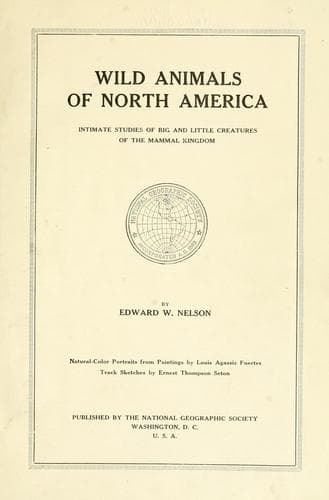
Wild Animals of North America: Intimate Studies of Big and Little Creatures of the Mammal KingdomNelson, Edward William
Science
Wild Animals of North America: Intimate Studies of Big and Little Creatures of the Mammal Kingdom
Nelson, Edward William
Mammals -- North America
Off Newfoundland the young harp seal is born early in March, wearing
a woolly white coat. At first it is tenderly cared for by its mother,
but before the end of April it has learned to swim and is left to care
for itself. The young do not enter the water until they are nearly two
weeks old and require several days of practice before they learn to
swim well. The adults are notable for their swiftness in the water.
In the tremendous herds of these seals the continual cries uttered by
old and young is said to produce a steady roar which may be heard for
several miles. Their food is mainly fish. Man is their worst enemy, but
they are also preyed upon by sharks and killer whales.
=RIBBON SEAL= (=Phoca fasciata=) (see polar bear group, page
438)
The broad-banded markings of the male ribbon seal render it the
handsomest and most strongly characterized of the group of hair seals
to which it belongs. Its size is about that of the harbor seal. Its
range extends from the Aleutian Islands, on the coast of Alaska, and
from the Kuriles, on the Asiatic shore of the Pacific, north to Bering
Straits.
This seal is so scarce and its home is in such remote and
little-frequented waters that its habits are almost unknown. Apparently
it is even less gregarious than the harbor seal and usually occurs
singly, although a few may be seen together, where individuals chance
to meet. There are records of its capture at various places along the
Asiatic coast, especially about Kamchatka and the shores of Okhotsk
Sea. In Alaska it is a scarce visitant to the Aleutian Islands and
appears to be most common on the coast south of the Yukon Delta and
from Cape Nome to Bering Straits.
The few individuals taken by the Alaskan Eskimos are captured while
they are hunting other seals on the pack ice in winter, and while at
sea in kyaks in spring and fall. Owing to its attractive markings, the
skin of the male ribbon seal is greatly prized by the Eskimos, as it
was formerly by the fur traders, for use as clothes-bags. The skin is
removed entire and then tanned, the only opening left being a long
slit in the abdomen, which is provided with eyelet holes and a lacing
string, thus making a convenient water-proof bag to use in boat or
dog-sledge trips.
The scarcity of the ribbon seal and its solitary habits will serve to
safeguard it from the destructive pursuit which endangers the existence
of some of its relatives.
POLAR BEAR (Thalarctos maritimus)
Both summer and winter the great ice bear of the frozen north is
appropriately clothed in white. It is also distinguished from all other
bears by its long neck, slender pointed head, and the quantity of fur
on the soles of its feet. It is a circumpolar species, the limits of
whose range nearly everywhere coincide with the southern border of
the pack ice. The great majority live permanently on the ice, often
hundreds of miles from the nearest land.
Public-domain text, read in full here on John Shaqi.
Reviews
Reviews
No reviews yet
Be the first to share your thoughts on this work.
Elsewhere in the archive
Join the Discussion
Join the discussion
Sign in to leave a comment or review.
Sign InorCreate an account