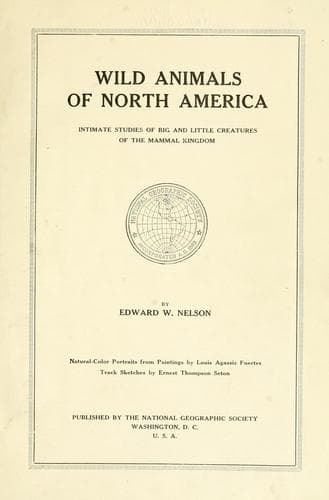
Wild Animals of North America: Intimate Studies of Big and Little Creatures of the Mammal KingdomNelson, Edward William
Science
Wild Animals of North America: Intimate Studies of Big and Little Creatures of the Mammal Kingdom
Nelson, Edward William
Mammals -- North America
It is nearly circumpolar in distribution, but its area of greatest
abundance extends from the Gulf of St. Lawrence to Greenland, and
thence eastward in that part of the Arctic Ocean lying north of Europe
and western Siberia. Its reported presence in the Arctic basin north
of Bering Straits or along the coasts to the southward is yet to be
confirmed. It is an offshore species, migrating southward with the ice
pack in fall to the coast of Newfoundland and returning northward with
the pack after the breeding season in spring. For a day or two during
the fall migration, when these seals are passing certain points on the
coast of Labrador, the sea is said to be thickly dotted with their
heads as far as the eye can reach, all moving steadily southward.
The harp seal is extremely gregarious and gathers on the pack ice well
offshore during March and April to breed. The main breeding grounds
are off Newfoundland and off Jan Mayen Land in the Arctic. During the
breeding season, in the days of their abundance, they gathered in
enormous closely packed herds, sometimes containing several hundred
thousand animals and covering the ice for miles.
[Illustration: SEA OTTER]
[Illustration: NORTHERN SEA-ELEPHANT, OR ELEPHANT SEAL]
From all accounts it is evident that originally there were millions of
these animals in the North Atlantic and Arctic Oceans. Their gregarious
habits made them an easy prey, and the value of their skins and blubber
formed the basis for a great industry. Hundreds of vessels were
sent out from north European and American ports and nearly 1,000,000
harp seals were killed during each breeding season. This tremendous
slaughter and its attendant waste has resulted in the disappearance of
these seals from many of their former haunts and has alarmingly reduced
their numbers everywhere. Some are still killed off the coast of
Newfoundland, but the sealing industry, now insignificant as compared
with its former estate, is practically dead.
[Illustration:
HARBOR SEAL, OR LEOPARD SEAL HARP SEAL, SADDLE-BACK, OR GREENLAND SEAL]
The hunting of harp and other seals on the pack ice is an occupation
calling for such splendid qualities of virile hardihood in the face of
constant danger to life that its brutality has been little considered.
In this perilous work great numbers of hunters have been cast away and
frozen miserably on the drifting ice and many a sealing ship has been
lost with all hands.
Public-domain text, read in full here on John Shaqi.
Reviews
Reviews
No reviews yet
Be the first to share your thoughts on this work.
Elsewhere in the archive
Join the Discussion
Join the discussion
Sign in to leave a comment or review.
Sign InorCreate an account