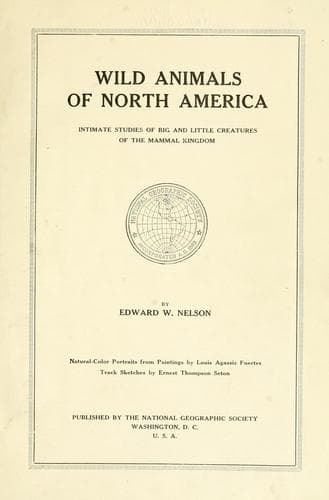
Wild Animals of North America: Intimate Studies of Big and Little Creatures of the Mammal KingdomNelson, Edward William
Science
Wild Animals of North America: Intimate Studies of Big and Little Creatures of the Mammal Kingdom
Nelson, Edward William
Mammals -- North America
Although powerful beasts, black bears are so shy and timid that to
approach them requires the greatest skill on the part of a still
hunter. They only attack people when wounded or so cornered that they
must defend themselves or their young. To safeguard themselves from
danger they rely mainly on a fine sense of hearing and an exquisite
delicacy of smell. They have poor eyesight, and where a suspicious
object is seen, but no sound or scent can be noted, they sometimes rise
on their hind feet and look long and carefully before retreating.
To bears in the forest everything is game. They often spend the entire
day turning over stones to lick up the ants and other insects sheltered
there, and at night may visit settlers’ cabins and carry off pigs. They
raid the settlers’ cornfields for green corn and are passionately fond
of honey, robbing bee trees whenever possible. In season they delight
in wild cherries, blueberries, and other fruits, as well as beechnuts,
acorns, and pinyon nuts. They are mainly nocturnal, but in districts
where not much disturbed wander widely by day.
The success of black bears in caring for themselves is well
demonstrated by the numbers which still survive in the woods of Maine,
New York, and other long-settled States. Their harmlessness and their
exceeding interest to all render them worthy of careful protection.
They should be classed as game and thoroughly protected as such except
for certain open seasons. If this is done throughout the country, as
is now the case in certain States, the survival of one of our most
characteristic large wild animals will be assured.
GLACIER BEAR (Ursus emmonsi)
When first discovered the glacier bear was supposed to be a distinct
and well-marked species. Recently cubs representing the glacier
bear and the typical black bear have been found in the same litter,
thus proving it to be merely a color phase of the black bear. Its
color varies exceedingly, from a light smoky, almost bluish,
gray to a dark iron gray, becoming almost black. Some individuals
are extraordinary appearing beasts, quite unlike any other bear.
The interest in this curious color development is increased by its
restricted distribution.
[Illustration:
RIBBON SEAL POLAR BEAR]
[Illustration:
GLACIER BEAR CINNAMON BEAR BLACK BEAR
The cinnamon bear is merely a color phase of the black bear.]
The glacier bear is an Alaskan animal, which occupies the seaward front
of the Mount St. Elias Range, about Yakutat Bay, and thence southeast
to Glacier Bay and a short distance beyond toward the interior. The
popular name of this bear was well chosen, as its home is in the
midst of innumerable stupendous glaciers. Here, where the contours of
gigantic mountain ranges are being steadily remade by glaciers, Nature
appears to have begun the evolution of a new kind of bear. That the
task is in progress is evidenced by the excessive variation in color,
scarcely two individuals being the same.
Public-domain text, read in full here on John Shaqi.
Reviews
Reviews
No reviews yet
Be the first to share your thoughts on this work.
Elsewhere in the archive
Join the Discussion
Join the discussion
Sign in to leave a comment or review.
Sign InorCreate an account