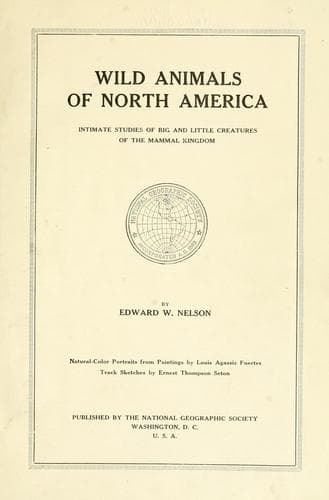
Wild Animals of North America: Intimate Studies of Big and Little Creatures of the Mammal KingdomNelson, Edward William
Science
Wild Animals of North America: Intimate Studies of Big and Little Creatures of the Mammal Kingdom
Nelson, Edward William
Mammals -- North America
Beavers mate permanently and have from two to five young each
year. Their abundance and the high value of their fur exercised an
unparalleled influence on the early exploration and development of
North America. Beaver skins were the one ready product of the New World
which the merchants of Europe were eager to purchase. As a consequence
competition in the trade for these skins was the source of strong and
bitter antagonisms between individuals and companies, and even
caused jealous rivalries among the Dutch, English, and French colonies.
[Illustration: GRIZZLY BEAR]
[Illustration: AMERICAN BEAVER]
Disputes over the right to trade in certain districts often led to
bloodshed, and even to long wars, over great areas, where powerful
rival companies fought for the control of a new empire. This eager
competition among daring adventurers resulted in the constant extension
of trading posts through the North and West, until the vanguard of
civilization reached the far borders of the continent on the shores of
the Arctic and Pacific Oceans.
Among the fur traders the beaver skin became the unit of value by
which barter was conducted for all sorts of commodities. This usage
extended even throughout northern Alaska, where it was current among
the American fur traders until the discovery of gold there upset old
standards.
Beavers belong to the rodent family--a group of animals notable for
their weak mental powers. The beaver is the striking exception to the
rule, and its extraordinary intelligence, industry, and skill have long
excited admiration. It is scarcely entitled to the almost superhuman
intelligence many endow it with, yet it certainly possesses surprising
ability along certain lines. Furthermore, it can alter its habits
promptly when a change in environment renders this advantageous.
In wild places, where rarely disturbed, beavers are unsuspicious, but
where they are much trapped they become amazingly alert and can be
taken only by the most skillful trapping. They are very proficient in
building narrow dams of sticks, mud, and small stones across small
streams for the purpose of backing up water and making “beaver ponds.”
In the border of these ponds a conical lodge is usually constructed of
sticks and mud. It is several feet high and about 8 or 10 feet across
at the base.
The entrance is usually under water, and a passageway leads to an
interior chamber large enough to accommodate the pair and their
well-grown young. From the ponds the animals sometimes dig narrow
canals several hundred feet long back through the flats among the
trees. Having short legs and heavy bodies, and consequently being
awkward on land, beavers save themselves much labor by constructing
canals for transporting the sticks and branches needed for food and for
repairing their houses and dams.
Public-domain text, read in full here on John Shaqi.
Reviews
Reviews
No reviews yet
Be the first to share your thoughts on this work.
Elsewhere in the archive
Join the Discussion
Join the discussion
Sign in to leave a comment or review.
Sign InorCreate an account