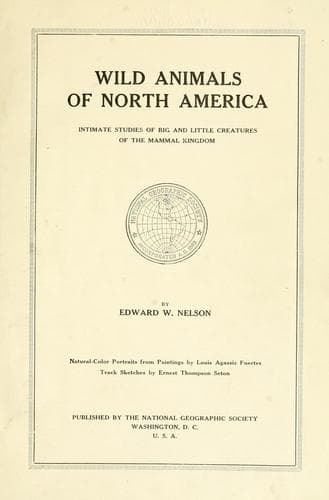
Wild Animals of North America: Intimate Studies of Big and Little Creatures of the Mammal KingdomNelson, Edward William
Science
Wild Animals of North America: Intimate Studies of Big and Little Creatures of the Mammal Kingdom
Nelson, Edward William
Mammals -- North America
Along the Colorado, lower Rio Grande, and other streams with high banks
and variable water level, beavers usually dig tunnels leading from an
entrance well under water to a snug chamber in the bank above water
level. Under the varying conditions in different areas they make homes
showing every degree of intergradation between the two types described.
Beavers live almost entirely on twigs and bark, and their gnawing
powers are surprising. Where small trees less than a foot in diameter
abound they are usually chosen, but the animals do not hesitate to
attack large trees. On the headwaters of the San Francisco River, in
western New Mexico. I saw a cottonwood nearly 30 inches in diameter
that had been felled so skillfully that it had fallen with the top in
the middle of a small beaver pond, thus assuring an abundance of food
for the animals at their very door.
In the cold northern parts of their range, where streams and ponds
remain frozen for months at a time, beavers gather freshly cut green
twigs, sticks, and poles, which they weight down with mud and stones on
the bottoms of ponds or streams near their houses, to be used for food
during the shut-in period.
The mud used by beavers in building dams and houses is scooped up and
carried against the breast, the front feet being used like hands. The
flat tail serves as a rudder when the animal is swimming or diving, and
to strike the surface of the water a resounding slap as a danger signal.
Beavers are usually nocturnal, but in districts where not disturbed
they sometimes come out to work by day, especially late in the
afternoon. Among the myriads of small streams and lakes in the great
forested area north of Quebec they are very plentiful; their dams and
houses are everywhere, sometimes four or five houses about one small
lake. Their well-worn trails lead through the woods near the lake
shores and frequently cross portages between lakes several hundred
yards apart.
Where beavers continue to occupy streams in settled districts, they
often make regular trails from a slide on the river bank back to
neighboring cornfields, where they feast on the succulent stalks and
green ears. They also injure orchards planted near their haunts, by
girdling or felling the trees. Within recent years laws for their
protection have been passed in many States, and beavers have been
reintroduced in a number of localities. They should not be colonized
in streams flowing through lands used for orchards or cornfields, nor
where the available trees are too few to afford a continuous food
supply.
FISHER, OR PEKAN (Mustela pennanti)
Public-domain text, read in full here on John Shaqi.
Reviews
Reviews
No reviews yet
Be the first to share your thoughts on this work.
Elsewhere in the archive
Join the Discussion
Join the discussion
Sign in to leave a comment or review.
Sign InorCreate an account