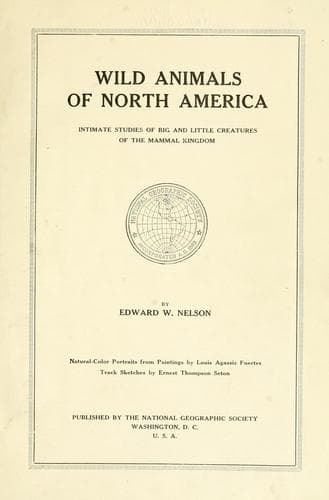
Wild Animals of North America: Intimate Studies of Big and Little Creatures of the Mammal KingdomNelson, Edward William
Science
Wild Animals of North America: Intimate Studies of Big and Little Creatures of the Mammal Kingdom
Nelson, Edward William
Mammals -- North America
The different forms of a species occupying areas under varying
conditions are commonly termed geographic races. They grade
imperceptibly into one another along the border between their ranges,
step by step with the gradations of the climatic and other conditions
which have produced their differences.
ANIMAL CHEMISTS CHANGE STARCH INTO WATER
One of the most striking modifications of mammalian economy by
environment is that shown in many small mammals of our southwestern
desert region and adjacent parts of Mexico, in which such species as
the kangaroo-rats, pocket-mice, prairie-dogs, and others are able to
exist under the most arid conditions without drinking. The liquid
necessary for supplying their bodily needs is obtained through chemical
action in their digestive tracts, whereby some of the starchy parts of
their food are changed into water.
Over considerable areas in the waterless deserts on the peninsula of
Lower California periods of from three to five years sometimes pass
without a drop of rain falling. In these areas the small desert mammals
named above, as well as wood-rats, white-footed mice, cottontails, and
jack-rabbits, are numerous and successfully pass these dry periods
without inconvenience. The absolute independence of water of these
animals has been demonstrated in southern California in the case of
pocket-mice kept for months in captivity in a box and fed solely upon
thoroughly dried seeds without their showing the slightest sign of
discomfort.
Our small mammals may be roughly classified by their food habits into
three main groups: Rodents, or gnawing animals; carnivores, or flesh
eaters, and insectivores, or insect eaters.
GNAWERS MOST NUMEROUS OF MAMMALS
The rodents vastly outnumber all other mammals and are typified by the
squirrels, rats, and mice; their food is mainly vegetable matter, but
many of them eat insects and meat whenever available. The carnivores,
including such species as the weasel, mink, and marten, are mainly
flesh eaters, preying largely upon rodents, but they also eat insects
and fruits of many kinds. The insectivores include the moles and
shrews, which, with all the bats found within our limits, are almost
exclusively eaters of worms and insects.
While rodents primarily feed on vegetable matter, it is surprising
to note the large number of species among them which commonly feed
on insects and have strong carnivorous propensities. This is not so
much the case with such larger rodents as the beaver, porcupine, and
woodchuck, but most of the smaller kinds, from squirrels to mice, have
been found to be confirmed flesh eaters.
[Illustration:
Photograph by Howard Taylor Middleton
A MILLENNIAL SCENE: A RABBIT-HOUND AND A YOUNG RABBIT ENJOYING EACH
OTHER’S SOCIETY
Here the camera records a friendship almost as remarkable as that which
is to mark the association of the lion and the lamb in the final days
of the world’s history.]
Public-domain text, read in full here on John Shaqi.
Reviews
Reviews
No reviews yet
Be the first to share your thoughts on this work.
Elsewhere in the archive
Join the Discussion
Join the discussion
Sign in to leave a comment or review.
Sign InorCreate an account