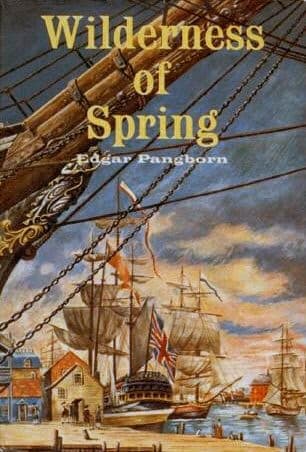
Historical fiction; United States -- History -- Colonial period, ca. 1600-1775 -- Fiction
"Blast!... If one may arrive at the end game--as I certainly can't here,
my friend--'tis not unlike old age, a time demanding some coolness and
precision and the summary of the ending, which is no simple matter of
victory or defeat or draw, I think."
"I like the simile, but I'm not sure living is a game."
"It is not, Reuben. I'm pleased you find the flaw. It will remind you
that any simile is a mischancy nag to ride. Ride him easy, perhaps for
entertainment only, and be ready to jump off before he blunders into the
ditch on the left which is marked _reductio ad absurdum_. If I said,
however, that living is a journey, would that be a simile?"
"No, sir, I call that a fair description, no flight of rhetoric."
"Mm-yas.... Let's see what remains for me here. I will try what the poor
Pawn can do, creeping into the breach, but I fear little David hath here
no slingshot."
"Well.... Well, I'm afraid he did leave it at home, Mr. Welland, for
this is checkmate."
"Ow!"
"Ben would say I had scuttled him, nautical language being ever on his
lips these days. He plays carelessly--in chess, I mean. And in living,
with the carelessness of generosity. But he'll win his end game."
"So much of what you say this afternoon ends with Ben! He's very close
to your heart, is he not?"
"Oh, we--were alway close."
"And went through much trouble together, I know, which it would seem
hath strengthened the tie, but with those of a different nature it might
have done the opposite. I had two brothers, Reuben. We drifted apart, as
they say--one lives now in England, the other died some years ago. After
childhood we were--oh, let us say like friends, but with strangely
little to say to one another. Cherish what you have--devotion is not
quite the commonest thing in the world."
"This noon, sir, I tried to tell him something. It should have been a
simple thing to say, but I lost myself in a most wonderful tangle of
misunderstanding--yes, and finally gave it up like a fool, though later
I thought of a dozen different ways I might have said it plainly."
"Mm-yas--a little strange. You speak clearly to me, as clearly as anyone
I can recall meeting, of any age."
"Well--well, I told him I intended coming here, and he at once supposed
that I thought I was ill, and then in reassuring him that it was nothing
like that, I somehow lost track of what I had meant to say, which
was--which was, sir, that one of my reasons in coming was to tell you
that I wish I might study medicine. Or at least hear whatever you might
tell me of such an ambition."
"Oh.... That was only one reason, Reuben?"
"Only one of--of many."
"Continue, Reuben."
"I'm confused about many things."
"So am I. But it's a good reason, seeing two candles are a trifle
brighter than one."
"And you said to me that you and I ought to be friends."
_Chapter Four_
Public-domain text, read in full here on John Shaqi.
Reviews
Reviews
No reviews yet
Be the first to share your thoughts on this work.
Elsewhere in the archive
Join the Discussion
Join the discussion
Sign in to leave a comment or review.
Sign InorCreate an account