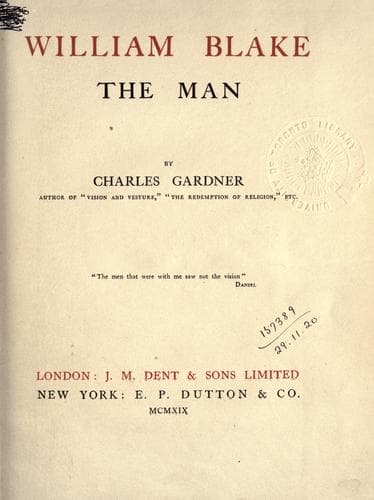
The truth is that Blake was not a great thinker, still less a
system-builder. He ought to have found the best Christian system while
young and kept to it. Then he could have lived his life of vision within
coherent bounds. Clear, sharp dogma, like outline in art, would have given
rest to his mind, substance to his visions, and saved him from the waste
of pouring out a torrent of incoherent sayings containing scraps of
gnosticism, theosophy, rosicrucianism, and almost every heresy under the
sun.
The master-mind in his youth who could have given him a sound system was
Dr Johnson, and he would not listen to him. How should the arch-rebel pay
any attention to the arch-conservator? Dr Johnson said many foolish things
about things of no great importance: he was wise in great matters. An
ounce of folly, like a dead fly in the ointment, suffices to put off the
fastidious rebel, who will seize hold of any excuse. Eventually Blake
subscribed to the same creed as Dr Johnson. That surely is a marvellous
unanimity for such diverse minds.
The master-mind in his age who could have given him a better system than
his own, and to whom he was beginning to listen, was Dante. His
catholicism may have been of a medieval pattern, but it was very little
infected with the time-spirit; it is even now finer than Swedenborg's
fabrication, and modern compared with the gnosticism that bulked so
largely in Blake's mind.
Blake makes no disciples, and no school can claim him, but he speaks to
all who have any mental equipment. His vision of Christ, if we can make it
our own and fill out its defects, will put us beyond the modern worship
of the superman, and take us out of that sectarianism which gains
ascendancy for a little while because of its lightness and
fragmentariness.
The confusion in Blake's mental life affects his art. He declared
consistently in times of clear vision that outline, form, and foundation
are the essence of spiritual things. This is beyond anything to be found
in Sir Joshua's _Discourses_, and anticipates Benedetto Croce when he says
that art is an ultimate, that "form is constant and is spiritual
activity," while "matter is changeable," yet he accomplished many designs
that Reynolds could have taught him to correct.
His later poems suffer still more. The energy in them is terrific, and
they are filled with flashes of inspiration; but their atmosphere is
murky, and never clears for more than fifty lines at a time. They are
storehouses, but the one who would get anything out of them must bring his
taper with him.
The early short poems, on the contrary, shine with their own light. _The
Tiger_ and _The Emmet_ are written before his mind has time to plunge into
the penumbra of his disorderly system.
Public-domain text, read in full here on John Shaqi.
Reviews
Reviews
No reviews yet
Be the first to share your thoughts on this work.
Elsewhere in the archive
Join the Discussion
Join the discussion
Sign in to leave a comment or review.
Sign InorCreate an account