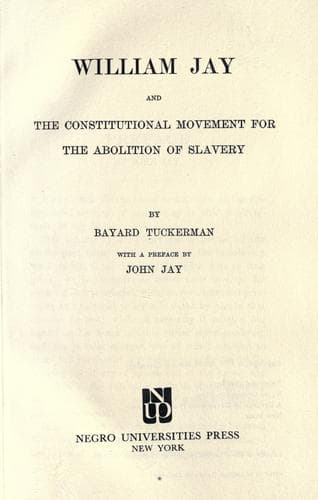
William Jay and the Constitutional Movement for the Abolition of SlaveryTuckerman, Bayard
History
William Jay and the Constitutional Movement for the Abolition of Slavery
Tuckerman, Bayard
Antislavery movements -- United States; Jay, William, 1789-1858; United States -- Politics and government -- 1815-1861
The organization of the American Bible Society in the face of the
opposition of the authorities in his own church displayed in Jay's early
life the self-reliance and independence of character which gave so much
strength to his later career. Always true to his church, he never
compromised his convictions to fit a position in which that church was
untrue to itself. During the antislavery movement the churches were
hostile. Fearful of alienating their Southern members and the Northern
men whose business interests demanded subserviency to the Slave Power,
hardly any ecclesiastical organization was guiltless of lending a
passive support to slavery. Theological students, on leaving their
seminary, were cautioned by their instructors to avoid the troublesome
topic if they would be successful ministers of Christ. Clergymen who
preached that property in man was sinful were disciplined by
ecclesiastical superiors or cast off by outraged Christian
congregations. An orthodox religious newspaper was the safest printed
matter for a Northern man to have in his possession when travelling in
the South. The Episcopal Church had its slaveholding bishops and
ministers, not a few of whom justified slavery from the Scriptures. It
had in the North its "cotton divines," who enjoined from the pulpit
obedience to the odious law which sought to make slave-catchers of
Christian men and women. It went so far as persistently to infringe its
own laws by shutting the doors of its conventions upon legally chosen
delegates of congregations composed of free coloured men. The church of
Christ was turned into a social club which did not hesitate to exclude a
black man as an "unfit associate." Shocked at this attitude, many
conscientious men withdrew from the communion. But such a course was
inconsistent with Jay's character. False and repulsive as was to him
such a conception of the Christian religion, he refused, as a churchman,
to accept it. He remained in the ranks, striving by his own conduct to
show that a man could be a good churchman and hate slavery at the same
time. Fearless in his expression of Christian truth, he was for twenty
years a thorn in the side of pro-slavery churchmen, and a rallying-point
for those who understood better the spirit of Christianity and
recognized the brotherhood of man before God.
Jay's private life was happy and peaceful. The library at Bedford, with
its book-shelves crowded to the ceiling and its windows looking out over
the hills of Westchester to the blue outlines of the Catskills, claimed
a considerable portion of every day. The hours there passed in
reflection and in literary labour were hours of pleasure, enhanced by
the desire and the hope of usefulness.
Public-domain text, read in full here on John Shaqi.
Reviews
Reviews
No reviews yet
Be the first to share your thoughts on this work.
Elsewhere in the archive
Join the Discussion
Join the discussion
Sign in to leave a comment or review.
Sign InorCreate an account