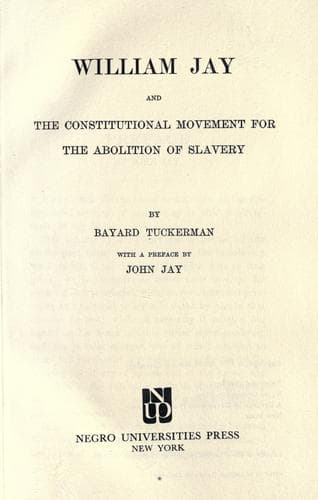
William Jay and the Constitutional Movement for the Abolition of SlaveryTuckerman, Bayard
History
William Jay and the Constitutional Movement for the Abolition of Slavery
Tuckerman, Bayard
Antislavery movements -- United States; Jay, William, 1789-1858; United States -- Politics and government -- 1815-1861
----, William, his birth, 1;
education, 2;
at Yale College, 4, 6;
studies law, 8;
marriage, 8;
begins life at Bedford, 8, 9;
begins philanthropic work, 10;
advocates Bible Societies, 10;
conflict with Bishop Hobart and High-Church party, 10, 11, 13;
organizes American Bible Society, 11, 12;
takes prize for essay on the Sabbath, 13;
for essay on duelling, 13;
appointed judge, 14;
early adoption of antislavery cause, 28;
espouses cause of Gilbert Horton, 29;
begins movement for abolition of slavery in District of Columbia,
29, 32, 34, 36, 37;
writes "Life of John Jay," 39;
his view of slavery problem in 1833, 43, 44;
consulted regarding formation of American Antislavery Society, 45;
advises acknowledgment of constitutional provisions, 45, 46;
invited to join in organizing the American Antislavery Society, 49;
his views on such an organization, 50;
suggests a definite avowal of constitutional principles, 50, 51;
becomes a member of Executive Committee of American Antislavery
Society, 57;
publishes his "Inquiry," 58;
its influence, 60, 61;
appointed foreign corresponding secretary, 63;
gives advice on right to use the mails, 65;
his "Address to the Public," 69;
elected president of New York State Antislavery Society, 77;
his reply to President Jackson's message, 78;
protests against the introduction of irrelevant doctrines into
antislavery societies, 84, 86, 100;
protests against unconstitutional doctrines, 87, 90;
defeats Alvan Stewart's resolution, 93;
his opinion of the danger of unconstitutional doctrines, 90, 94;
his opinion of Stewart's position, 95;
his loss of faith in the usefulness of antislavery societies, 97,
100;
placed on Executive Committee of American and Foreign Antislavery
Society, 103;
resigns membership in American Antislavery Society, 103;
views on the woman question, 103, 104;
his "View of the Action of the Federal Government," 105;
his "Condition of the Free People of Colour," 106;
his "Violation of the Right of Petition," 106;
his attitude towards Liberty party in 1840, 107, 108, 109;
his attitude towards antislavery societies after the schism, 112,
113, 114, 115, 116;
his attitude towards Liberty party in 1843, 117, 118, 119, 120, 121;
his views on the annexation of Texas, 118, 127, 128;
nominated for Senator by the Liberty party, 120;
deprived of his seat on the bench, 122;
his visit to Europe, 125;
his "Review of the Mexican War," 127, 128;
his "War and Peace," and plan for International arbitration, 130,
131;
his attitude towards the "come-outers," 132;
his work in the Episcopal Church in favour of the slave, 132, 133,
144, 145, 147, 162;
"Letter to Bishop Ives," 133;
reply to Webster, 137, 138;
Public-domain text, read in full here on John Shaqi.
Reviews
Reviews
No reviews yet
Be the first to share your thoughts on this work.
Elsewhere in the archive
Join the Discussion
Join the discussion
Sign in to leave a comment or review.
Sign InorCreate an account