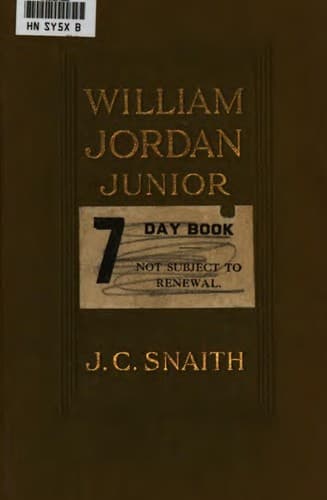
Booksellers and bookselling -- Fiction; Fathers and sons -- Fiction; London (England) -- Fiction; Poets -- Fiction
As William Jordan went forth of the little room and took his ways,
the east had still no more than a few faint grey flecks, which were
hardly more than vaunt-couriers of the hues of dawn. Into the ruck of
the streets he took his way. He plunged into them headlong, without
calculation, without attempting to discriminate. Yet there was neither
hurry of the flesh nor of the spirit; both were rational, temperate,
responsible.
The rain had ceased; but the black pavements were slippery and
unwholesome, and there was the stench of a thousand drains. Street
after street he passed through at the same regulated pace, which was
neither slow nor fast. Rows upon rows of houses which he had never seen
before came into view; and at last, as all the sky was bright with the
new day, he saw the green lanes, and began to taste the pure woodland
airs.
As soon as he knew himself to be free of the great city, he left the
highways and struck a direct course across the green fields. Over the
hedgerows and across the pastures he bent his steps; across morasses
and through tangled places, not knowing nor desiring to know whither;
past hamlets with thatched roofs, and crooked rustic churches; past
farm steadings; past stately mansions; over upland and fen, until
the sun had reached its zenith in the heavens. He then sat on the
hospitable earth, and for a space rested his weariness on the fringe of
a green wood, in a dry warm place, under a splendid tree, alive with
sap and the melody of birds.
When again he went his way the sun was still high in the April heaven,
though pursuing a steady track towards the west. The wayfarer followed
it in a straight line, over hedgerow and pasture, sometimes crossing a
brook with his naked feet; at other times leaping a ditch, or breaking
through barriers of thorn and timber which seemed insurmountable.
The wayfarer paid no heed to the miles that he made. As the light of
the sun began to fail, he found himself upon the wealds and uplands,
with the generous sweet-smelling earth ever beneath him. The evening
airs seemed to blow with a sharper sweetness; the houses and hamlets
grew fewer, yet nature’s spontaneity grew ever richer and more rare.
When it was almost dark he reached a little and solitary house on the
edge of a great wood. It seemed to be interminable, and full of pungent
yet delicately odorous trees. He knocked at the door of the little
house. His summons was answered by an old woman in a grey shawl; and
for a penny she gave him a cake of bread and a cup of water. He drank
the water like one who thirsts; and then he bore his limbs, which now
ached with weariness, into the gloomy precincts of the wood. Groping
about in the darkness, he found a dry and sheltered place amid the
fresh flowering furze; and here, with his head propped against the bole
of a young pine, he ate his food slowly, and then straightway fell into
a profound sleep.
Public-domain text, read in full here on John Shaqi.
Reviews
Reviews
No reviews yet
Be the first to share your thoughts on this work.
Elsewhere in the archive
Join the Discussion
Join the discussion
Sign in to leave a comment or review.
Sign InorCreate an account