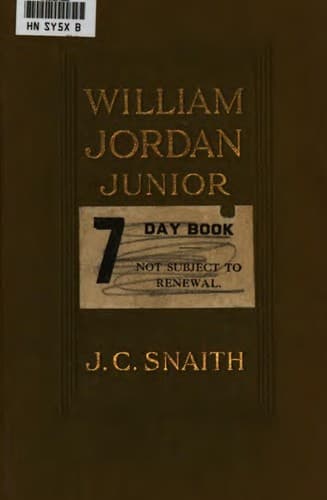
Booksellers and bookselling -- Fiction; Fathers and sons -- Fiction; London (England) -- Fiction; Poets -- Fiction
“Yuss,” said the driver as the hansom moved off slowly, “if the old
hoss will stand to the scenery. If he ain’t taking any it will have to
be _viâ_ Mentone and the Lake o’ Geneva.”
To the boy’s dismay, the hansom seemed hardly to move beyond a crawl.
It went along several narrow by-streets off the Strand which he had
never seen before. As he sat in the hansom a faint recollection
returned to him that Trafalgar Square must be “over there.” But the
cab-driver street-person seemed to be taking him in the opposite
direction.
They passed a clock. It was a quarter to twelve. Why didn’t the
horse go faster? Then he remembered with a pang that the cab-driver
street-person had said it was old. How injudicious he had been to
choose an old horse! He should have chosen a young horse when speed
was of such paramount importance. But what was the difference between
a young horse and an old horse? Had his life depended on the answer,
he could not have told. What a lot of obscure knowledge there was to
acquire in the practical sciences! Every step he took alone among the
streets of the great city some new problem confronted him--problems
which no mind could foreshadow unless it experienced them first. Less
than an hour ago, when he left the little room, after striving all
through the long night to foresee every contingency that was likely
to arise, after drawing up the “programme” with such minute care, it
had not entered his head that he would have to ride in a cab, and be
called upon to discriminate between an old horse and a young one.
The poor old animal seemed scarcely to push one leg before the other.
If only he knew the way, and he knew how to get out of the cab, he
would be able to run much faster. Yet the cab and himself and the
driver must be cruel burdens for the poor old horse. He felt a pitiless
street-person to be sitting there, preoccupied with his own affairs,
while he inflicted sufferings upon a dumb animal. But he must, he must,
he must be at No. 24 Trafalgar Square as the clocks gave the hour of
twelve!
What was that! The chimes of a clock. One, two, three, four; four
quarters of the hour! His heart sank. It was all over. The first stroke
of the hour of twelve was striking. His pilgrimage had been made in
vain. He had one more failure to record. He would never, his sinking
heart informed him, be able to retain the little room.
Then he found that the hansom had stopped altogether. The solemn face
of the cab-driver street-person peered at him through a hole in the
roof.
“Here y’are, Captain,” he said, with a pride that was finely
restrained, “number twenty-four. The old ’oss ’as done it on ’is ’ead.”
The boy was out of the vehicle at a bound. He cried to the cabman, “Oh,
t-thank you, oh, t-thank you!”
The fifth stroke of twelve had struck. No. 24 was displayed on a
door six yards away. Beside it was a brass plate inscribed, _Messrs.
Crumpett and Hawker, Publishers_.
Public-domain text, read in full here on John Shaqi.
Reviews
Reviews
No reviews yet
Be the first to share your thoughts on this work.
Elsewhere in the archive
Join the Discussion
Join the discussion
Sign in to leave a comment or review.
Sign InorCreate an account