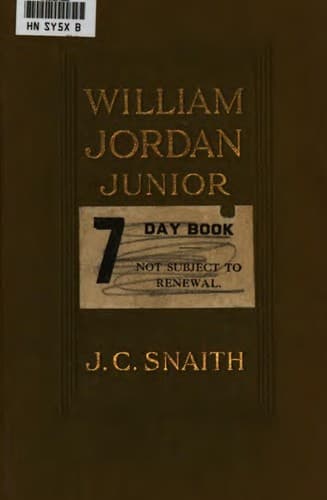
Booksellers and bookselling -- Fiction; Fathers and sons -- Fiction; London (England) -- Fiction; Poets -- Fiction
“I never thought to see this hour,” said the boy, gathering up the
pieces of silver and placing them in his father’s hand. “I know not
what they have cost me, my father, but now I would that the cost were a
hundred times more.”
“Is it not a pious thought, beloved one,” said his father, “that that
which we render is given to us again?”
“I have wrought greatly in the practical sciences during the week past,
my father,” said the boy. “My power increases hour by hour; the persons
in the streets are nothing like so mysterious to me as they were; and
yet still there are great waste places. There is, indeed, much to
learn, my father, much to learn.”
To-night his mood was one of rare expansion. He spoke unceasingly of
what the future bore. The ten pieces of silver acted like a wine of
great potency upon the too-delicate strings of the mind.
“Every day, every hour, every minute I am growing in stature,” he said.
“Every time my heart beats, my father, I am more than I was. To-night I
feel a royal courage stirring in my flesh. There is much to learn, my
father, much to learn, but one day I feel sure I shall learn it all.”
“And when thou hast learnt it all, Achilles?” his father asked.
“Why--why of course, my father, when I have learnt it all I shall
commence author,” said the boy.
That evening, for the first time in his life, he showed his contempt
for the darkness by going up-stairs to bed without a candle. His father
continued to sit at the table in the little room all the night through,
consulting one page after another of the aged tome, which was bound
so massively, until the chill morning light crept over the top of
the shutters. He then walked out bare-headed, slow of gait, into the
vapours of the dawn.
XVII
During the week which followed, the behaviour of William Jordan,
Junior, was very closely scrutinized by his fellow-labourers in the
vineyard of No. 24 Trafalgar Square. One and all were freely inoculated
with the “traditions of the house.” Each member of the counting-house
staff, from Mr. Dodson, who might be of any age and standing, to Mr.
Walter Pater Walkinshaw, Mr. Aristophanes Luff, Mr. Leslie Stephen
Sandars, and Mr. T. B. Macaulay Jenkins, who unmistakably were of one
particular period and degree, were infected by a generous jealousy
for the name and fame “of the first publishing house in London, and
therefore of the civilized world.”
“It ain’t, you know,” Mr. James Dodson communicated to William Jordan,
Junior, in his second or unofficial manner, “but Octavius thinks so,
and what Octavius thinks the staff has got d---- well to believe.”
Public-domain text, read in full here on John Shaqi.
Reviews
Reviews
No reviews yet
Be the first to share your thoughts on this work.
Elsewhere in the archive
Join the Discussion
Join the discussion
Sign in to leave a comment or review.
Sign InorCreate an account