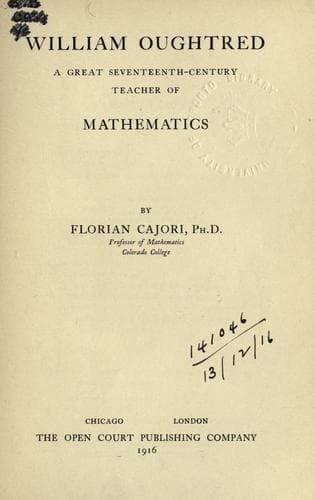
William Oughtred: A Great Seventeenth-Century Teacher of MathematicsCajori, Florian
History
William Oughtred: A Great Seventeenth-Century Teacher of Mathematics
Cajori, Florian
Mathematicians -- Biography; Mathematics -- Study and teaching -- History -- 17th century; Oughtred, William, 1575-1660
That there continued to be a group of students and teachers who desired a
fuller exposition than is given by Oughtred is evident from the
appearance, over fifty years after the first publication of the Clavis,
of a booklet by Gilbert Clark, entitled Oughtredus Explicatus, London,
1682. A review of this appeared in the Acta Eruditorum (Leipzig, 1684),
on p. 168, wherein Oughtred is named “clarissimus Angliae mathematicus.”
John Collins wrote Wallis in 1666-67 that Clark, “who lives with Sir
Justinian Isham, within seven miles of Northampton, . . . . intimates he
wrote a comment on the Clavis, which lay long in the hands of a printer,
by whom he was abused, meaning Leybourne.”[64]
We shall have occasion below to refer to Oughtred’s inability to secure a
copy of a noted Italian mathematical work published a few years before.
In those days the condition of the book trade in England must have been
somewhat extraordinary. Dr. J. W. L. Glaisher throws some light upon this
subject.[65] He found in the Calendar of State Papers, Domestic Series,
1637, a petition to Archbishop Laud in which it is set forth that when
Hooganhuysen, a Dutchman, “heretofore complained of in the High
Commission for importing books printed beyond the seas,” had been bound
“not to bring in any more,” one Vlacq (the computer and publisher of
logarithmic tables) “kept up the same agency and sold books in his stead.
. . . . Vlacq is now preparing to go beyond the seas to avoid answering
his late bringing over nine bales of books contrary to the decree of the
Star Chamber.” Judgment was passed that, “Considering the ill-consequence
and scandal that would arise by strangers importing and venting in this
kingdom books printed beyond the seas,” certain importations be
prohibited, and seized if brought over.
This want of easy intercommunication of results of scientific research in
Oughtred’s time is revealed in the following letter, written by Oughtred
to Robert Keylway, in 1645:
I speak this the rather, and am induced to a better confidence of your
performance, by reason of a geometric-analytical art or practice found
out by one Cavalieri, an Italian, of which about three years since I
received information by a letter from Paris, wherein was praelibated
only a small taste thereof, yet so that I divine great enlargement of
the bounds of the mathematical empire will ensue. I was then very
desirous to see the author’s own book while my spirits were more free
and lightsome, but I could not get it in France. Since, being more
stept into years, daunted and broken with the sufferings of these
disastrous times, I must content myself to keep home, and not put out
to any foreign discoveries.[66]
Public-domain text, read in full here on John Shaqi.
Reviews
Reviews
No reviews yet
Be the first to share your thoughts on this work.
Join the Discussion
Join the discussion
Sign in to leave a comment or review.
Sign InorCreate an account