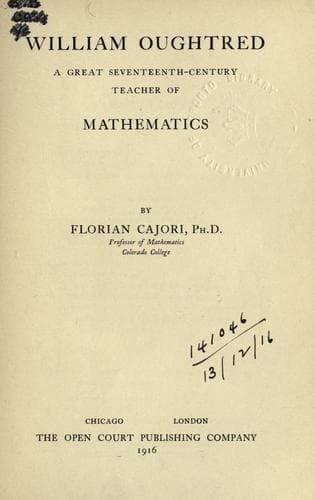
William Oughtred: A Great Seventeenth-Century Teacher of Mathematics — John Shaqi
William Oughtred: A Great Seventeenth-Century Teacher of MathematicsCajori, Florian
History
William Oughtred: A Great Seventeenth-Century Teacher of Mathematics
Cajori, Florian
Mathematicians -- Biography; Mathematics -- Study and teaching -- History -- 17th century; Oughtred, William, 1575-1660
It was not my intent to disparage the author, though I know many that
did lightly esteem him when living, some whereof are at rest, as Mr.
Foster and Mr. Gibson. . . . . You grant the author is brief, and
therefore obscure, and I say it is but a collection, which, if himself
knew, he had done well to have quoted his authors, whereto the reader
might have repaired. You do not like those words of Vieta in his
theorems, ex adjunctione plano solidi, plus quadrato quadrati, etc.,
and think Mr. Oughtred the first that abridged those expressions by
symbols; but I dissent, and tell you ’twas done before by Cataldus,
Geysius, and Camillus Gloriosus,[69] who in his first decade of
exercises, (not the first tract,) printed at Naples in 1627, which was
four years before the first edition of the Clavis, proposeth this
equation just as I here give it you, viz.
1ccc+16qcc+41qqc-2304cc-18364qc-133000qq-54505c+3728q+8064 N aequatur
4608, finds N or a root of it to be 24, and composeth the whole out of
it for proof, just in Mr. Oughtred’s symbols and method. Cataldus on
Vieta came out fifteen years before, and I cannot quote that, as not
having it by me.
. . . . And as for Mr. Oughtred’s method of symbols, this I say to it;
it may be proper for you as a commentator to follow it, but divers I
know, men of inferior rank that have good skill in algebra, that
neither use nor approve it. . . . . Is not A⁵ sooner wrote than A_qc?
Let A be 2, the cube of 2 is 8, which squared is 64: one of the
questions between Maghet Grisio and Gloriosus is whether 64=A_cc or
A_qc. The Cartesian method tells you it is A⁶, and decides the doubt. .
. . .[70]
There is some ground for the criticisms passed by Collins. To be sure,
the first edition of the Clavis is dated 1631—six years before Descartes
suggested the exponential notation which came to be adopted as the
symbolism in our modern algebra. But the second edition of the Clavis,
1647, appeared ten years after Descartes’ innovation. Had Oughtred seen
fit to adopt the new exponential notation in 1647, the step would have
been epoch-making in the teaching of algebra in England. We have seen no
indication that Oughtred was familiar with Descartes’ Géométrie of 1637.
The year preceding Oughtred’s death Mr. John Twysden expressed himself as
follows in the preface to his Miscellanies:
Public-domain text, read in full here on John Shaqi.
Reviews
Reviews
No reviews yet
Be the first to share your thoughts on this work.
Join the Discussion
Join the discussion
Sign in to leave a comment or review.
Sign InorCreate an account