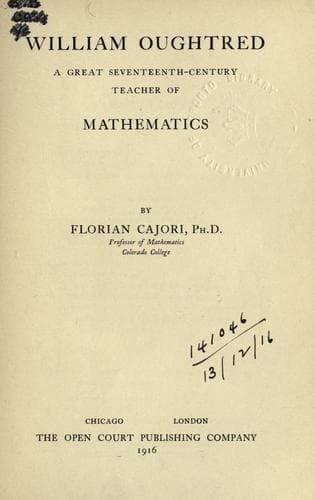
William Oughtred: A Great Seventeenth-Century Teacher of MathematicsCajori, Florian
History
William Oughtred: A Great Seventeenth-Century Teacher of Mathematics
Cajori, Florian
Mathematicians -- Biography; Mathematics -- Study and teaching -- History -- 17th century; Oughtred, William, 1575-1660
We have noticed that the notation A:B::C:D antedates the year 1657.
Vincent Wing, the astronomer, published in 1651 in London the Harmonicon
coeleste, in which is found not only Oughtred’s notation A.B::C.D but
also the modified form of it given above. The two are used
interchangeably. His later works, the Logistica astronomica (1656),
Doctrina spherica (1655), and Doctrina theorica, published in one volume
in London, all use the symbols A:B::C:D exclusively. The author of a book
entitled, An Idea of Arithmetick at first designed for the use of the
Free Schoole at Thurlow in Suffolk . . . . by R. B., Schoolmaster there,
London, 1655, writes A:a::C:c, though part of the time he uses Oughtred’s
unmodified notation.
We can best indicate the trend in England by indicating the authors of
the seventeenth century whom we have found using the notation A:B::C:D
and the authors of the eighteenth century whom we have found using
A.B::C.D. The former notation was the less common during the seventeenth
but the more common during the eighteenth century. We have observed the
symbols A:B::C:D (besides the authors already named) in John Collins
(1659),[93] James Gregory (1663),[94] Christopher Wren (1668-69),[95]
William Leybourn (1673),[96] William Sanders (1686),[97] John Hawkins
(1684),[98] Joseph Raphson (1697),[99] E. Wells (1698),[100] and John
Ward (1698).[101]
Of English eighteenth-century authors the following still clung to the
notation A.B::C.D: John Harris’ translation of F. Ignatius Gaston Pardies
(1701),[102] George Shelley (1704),[103] Sam Cobb (1709),[104] J. Collins
in Commercium Epistolicum (1712), John Craig (1718),[105] Jo. Wilson
(1724).[106] The latest use of A.B::C.D which has come to our notice is
in the translation of the Analytical Institutions of Maria G. Agnesi,
made by John Colson sometime before 1760, but which was not published
until 1801. During the seventeenth century the notation A:B::C:D acquired
almost complete ascendancy in England.
In France Oughtred’s unmodified notation A.B::C.D, having been adopted
later, was also discarded later than in England. An approximate idea of
the situation appears from the following data. The notation A.B::C.D was
used by M. Carré (1700),[107] M. Guisnée (1705),[108] M. de Fontenelle
(1727),[109] M. Varignon (1725),[110] M. Robillard (1753),[111] M.
Sebastien le Clerc (1764),[112] Clairaut (1731),[113] M. L’Hospital
(1781).[114]
In Italy Oughtred’s modified notation a, b::c, d was used by Maria G.
Agnesi in her Instituzioni analitiche, Milano, 1748. The notation
a:b::c:d found entrance the latter part of the eighteenth century. In
Germany the symbolism a:b=c:d, suggested by Leibniz, found wider
acceptance.[115]
Public-domain text, read in full here on John Shaqi.
Reviews
Reviews
No reviews yet
Be the first to share your thoughts on this work.
Elsewhere in the archive
Join the Discussion
Join the discussion
Sign in to leave a comment or review.
Sign InorCreate an account