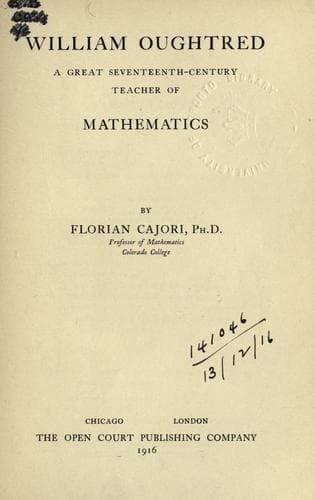
William Oughtred: A Great Seventeenth-Century Teacher of MathematicsCajori, Florian
History
William Oughtred: A Great Seventeenth-Century Teacher of Mathematics
Cajori, Florian
Mathematicians -- Biography; Mathematics -- Study and teaching -- History -- 17th century; Oughtred, William, 1575-1660
It is evident from the data presented that Oughtred proposed his notation
for ratio and proportion at a time when the need of a specific notation
began to be generally felt, that his symbol for ratio a.b was temporarily
adopted in England and France but gave way in the eighteenth century to
the symbol a:b, that Oughtred’s symbol for proportion :: found almost
universal adoption in England and France and was widely used in Italy,
the Netherlands, the United States, and to some extent in Germany; it has
survived to the present time but is now being gradually displaced by the
sign of equality =.
Oughtred’s notation to express aggregation of terms has received little
attention from historians but is nevertheless interesting. His books, as
well as those of John Wallis, are full of parentheses but they are not
used as symbols of aggregation in algebra; they are simply marks of
punctuation for parenthetical clauses. We have seen that Oughtred writes
(a+b)² and √(a+b) thus, Q:a+b:, √:a+b:, or Q:a+b, √:a+b, using on rarer
occasions a single dot in place of the colon. This notation did not
originate with Oughtred, but, in slightly modified form, occurs in
writings from the Netherlands. In 1603 C. Dibvadii in geometriam Evclidis
demonstratio numeralis, Leyden, contains many expressions of this sort,
√·136+√2048, signifying √(136+√2048). The dot is used to indicate that
the root of the binomial (not of 136 alone) is called for. This notation
is used extensively in Ludolphi à Cevlen de circulo, Leyden, 1619, and in
Willebrordi Snellii De circuli dimensione, Leyden, 1621. In place of the
single dot Oughtred used the colon (:), probably to avoid confusion with
his notation for ratio. To avoid further possibility of uncertainty he
usually placed the colon both before and after the algebraic expression
under aggregation. This notation was adopted by John Wallis and Isaac
Barrow. It is found in the writings of Descartes. Together with Vieta’s
horizontal bar, placed over two or more terms, it constituted the means
used almost universally for denoting aggregation of terms in algebra.
Before Oughtred the use of parentheses had been suggested by Clavius[116]
and Girard.[117] The latter wrote, for instance, √(2+√3). While
parentheses never became popular in algebra before the time of Leibniz
and the Bernoullis they were by no means lost sight of. We are able to
point to the following authors who made use of them: I. Errard de
Bar-le-Duc (1619),[118] Jacobo de Billy (1643),[119] one of whose books
containing this notation was translated into English, and also the
posthumous works of Samuel Foster.[120] J. W. L. Glaisher points out that
parentheses were used by Norwood in his Trigonometrie (1631), p. 30.[121]
Public-domain text, read in full here on John Shaqi.
Reviews
Reviews
No reviews yet
Be the first to share your thoughts on this work.
Elsewhere in the archive
Join the Discussion
Join the discussion
Sign in to leave a comment or review.
Sign InorCreate an account