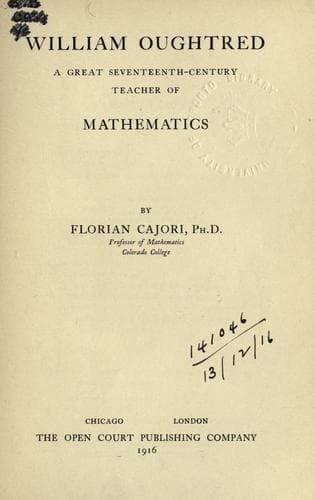
William Oughtred: A Great Seventeenth-Century Teacher of MathematicsCajori, Florian
History
William Oughtred: A Great Seventeenth-Century Teacher of Mathematics
Cajori, Florian
Mathematicians -- Biography; Mathematics -- Study and teaching -- History -- 17th century; Oughtred, William, 1575-1660
[30]See F. Cajori, “The Cross × as a Symbol of Multiplication,” in
Nature, Vol. XCIV (1914), p. 363.
[31]See Elementi decimi Euclidis declaratio, 1652, p. 2.
[32]See Johannis Wallisii Operum mathematicorum pars prima, Oxonii, 1657,
p. 247.
[33]Clavis of 1631, chap. xix, sec. 5, p. 50.
[34]We have noticed the representation of known quantities by consonants
and the unknown by vowels in Wingate’s Arithmetick made easie, edited
by John Kersey, London, 1650, algebra, p. 382; and in the second part,
section 19, of Jonas Moore’s Arithmetick in two parts, London, 1660,
Moore suggests as an alternative the use of z, y, x, etc., for the
unknowns. The practice of representing unknowns by vowels did not
spread widely in England.
[35]Philosophical Transactions, Vol. XIX, No. 231, London, p. 652.
[36]Ibid., Vol. XIX, p. 56.
[37]There are two title-pages to the edition of 1632. The first
title-page is as follows: The Circles of Proportion and The
Horizontall Instrument. Both invented, and the vses of both Written in
Latine by Mr. W. O. Translated into English: and set forth for the
publique benefit by William Forster. London. Printed for Elias Allen
maker of these and all other mathematical Instruments, and are to be
sold at his shop over against St. Clements church with out
Temple-barr. 1632. T. Cecill Sculp.
In 1633 there was added the following, with a separate title-page: An
addition vnto the Vse of the Instrvment called the Circles of
Proportion. . . . . London, 1633, this being followed by Oughtred’s To
the English Gentrie etc. In the British Museum there is a copy of
another impression of the Circles of Proportion, dated 1639, with the
Addition vnto the Vse of the Instrument etc., bearing the original
date, 1633, and with the epistle, To the English Gentrie, etc.,
inserted immediately after Forster’s dedication, instead of at the end
of the volume.
[38]The complete title of the English edition is as follows:
Trigonometrie, or, The manner of calculating the Sides and Angles of
Triangles, by the Mathematical Canon, demonstrated. By William
Oughtred Etonens. And published by Richard Stokes Fellow of Kings
Colledge in Cambridge, and Arthur Haughton Gentleman. London, Printed
by R. and W. Leybourn, for Thomas Johnson at the Golden Key in St.
Pauls Church-yard. M.DC.LVII.
[39]Jer. Collier, The Great Historical, Geographical, Genealogical and
Poetical Dictionary, Vol. II, London, 1701, art. “Oughtred.”
[40]Rigaud op. cit., Vol. I, p. 82.
[41]A. De Morgan, Budget of Paradoxes, London, 1872, p. 451; 2d ed.,
Chicago, 1915, Vol. II, p. 303.
[42]E. Gunter, Description and Use of the Sector, the Crosse-staffe and
other Instruments, London, 1624, second book, p. 31.
[43]F. Cajori, “On the History of a Notation in Trigonometry,” Nature,
Vol. XCIV, 1915, pp. 642, 643.
Public-domain text, read in full here on John Shaqi.
Reviews
Reviews
No reviews yet
Be the first to share your thoughts on this work.
Elsewhere in the archive
Join the Discussion
Join the discussion
Sign in to leave a comment or review.
Sign InorCreate an account