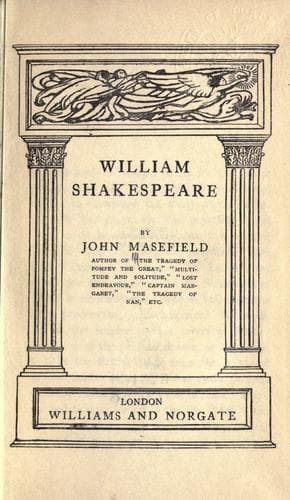
Shakespeare, William, 1564-1616 -- Criticism and interpretation
_Source of the Plot._ The story is founded on an event that is said
to have taken place in Ferrara, during the Middle Ages. Shakespeare
took it from a collection of novels, the _Hecatomithi_, by Giraldi
Cinthio; from the play, _The rare Historie of Promos and
Cassandra_, founded on Cinthio's novel, by one George Whetstone,
and from Whetstone's prose rendering of the story in his book _The
Heptameron of Civil Discourses_.
_The Fable._ The Duke of Vienna, going on a secret mission, leaves
his power in the hands of Angelo, a man of strict life.
Angelo enforces old laws against incontinence. He arrests Claudio
and sentences him to be beheaded. Claudio's sister, Isabella,
pleads with Angelo for her brother's life. Being moved to lust,
Angelo tempts Isabella. He offers to spare Claudio if she will
submit to him. Claudio begs her to save him thus. She refuses.
The Duke returns to Vienna disguised, hears Isabella's story, and
resolves to entrap Angelo. He causes her to make an appointment to
that end. He causes Mariana, a maid who has been jilted by Angelo,
to personate Isabella, and keep the appointment. Mariana does so.
He contrives to check Angelo's treachery, that would have caused
Claudio's death in spite of the submission.
Lastly he reveals himself, exposes Angelo's sin, compels him to
marry Mariana, pardons Claudio, and makes Isabella his Duchess.
This play is now seldom performed. It is one of the greatest works of
the greatest English mind. It deals justly with the case of the man who
sets up a lifeless sentimentality as a defence against a living natural
impulse. The spirit of Angelo has avenged itself on Shakespeare by
becoming the guardian spirit of the British theatre.
In this play Shakespeare seems to have brooded on the fact that the
common prudential virtues are sometimes due, not to virtue, but to some
starvation of the nature. Chastity may proceed from a meanness in the
mind, from coldness of the emotions, or from cowardice, at least as
often as from manly and cleanly thinking. Two kinds of chastity are set
at clash here. The one springs from a fire in the personality that
causes Isabella to think death better than contamination, and gives her
that whiteness of generosity which fills nunneries with living
sacrifice; the other comes from the niggardliness that makes Angelo jilt
Mariana rather than take her without a dower. Both are obsessions; both
exalt a part of life above life itself. Like other obsessions, they
come to grief in the presence of something real.
Public-domain text, read in full here on John Shaqi.
Reviews
Reviews
No reviews yet
Be the first to share your thoughts on this work.
Join the Discussion
Join the discussion
Sign in to leave a comment or review.
Sign InorCreate an account