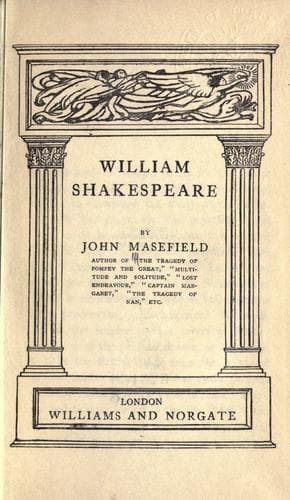
Shakespeare, William, 1564-1616 -- Criticism and interpretation
These two characters make the action. The play is concerned with the
difficulty of doing justice in a world of animals swayed by rumour. The
subject is one that occupied Shakespeare's mind throughout his creative
life. Wisdom begins in justice. But how can man be just, without the
understanding of God? Who is so faultless that he can sit in judgment on
another? Who so wise that he can see into the heart, weigh the act with
the temptation and strike the balance?
Sexual sin is the least of the sins in Dante. It is allied to love. It
is an image of regeneration. No sin is so common, none is more glibly
blamed. It is so easy to cry "treacherous," "base," and "immoral." But
who, while the heart beats, can call himself safe from the temptation to
this sin? It is mixed up with every generosity. It is a flood in the
heart and a blinding wave over the eyes. It is the thorn in the side
under the cloak of the beauty of youth. In Shakespeare's vision it is a
natural force, incident to youth, as April is incident to the year. The
young men live as though life were oil, and youth a bonfire to be burnt.
Life is always wasteful. Youth is life's test for manhood. The clown
finds in the prison a great company of the tested and rejected, calling
through the bars for alms. In spite of all this choice, another victim
is picked by tragical chance. Lucio, a butterfly of the brothel, a
dirtier soul than Claudio, is spared. Claudio is taken and condemned.
The beautiful, vain, high-blooded youth, so quick with life and glad of
the sun, is to lie in earth, at the bidding of one less full of April.
Public-domain text, read in full here on John Shaqi.
Reviews
Reviews
No reviews yet
Be the first to share your thoughts on this work.
Elsewhere in the archive
Join the Discussion
Join the discussion
Sign in to leave a comment or review.
Sign InorCreate an account