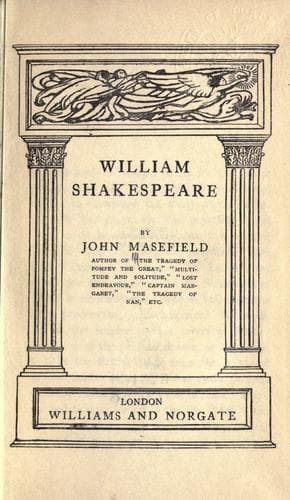
Shakespeare, William, 1564-1616 -- Criticism and interpretation
_Source of the Plot._ The tale appears in _The Hecatomithi_ of
G. B. Giraldi Cinthio. Shakespeare follows Cinthio in the main; but a
few details suggest that he knew the story in an ampler version.
_The Fable._ Iago, ensign to Othello, the Moor of Venice, is
jealous of Cassio, his lieutenant. He plots to oust Cassio from the
lieutenancy.
Othello marries Desdemona, and sails with her to the wars in
Cyprus. Iago resolves to make use of Desdemona to cause Cassio's
downfall.
He procures Cassio's discharge from the lieutenancy by involving
him in a drunken brawl. Cassio beseeches Desdemona to intercede
with Othello for him. Iago hints to Othello that she has good
reason to wish Cassio to be restored. He suggests that Cassio is
her lover. Partly by fortune, partly by craft, he succeeds in
establishing in Othello's mind the conviction that Desdemona is
guilty.
Othello smothers Desdemona, learns, too late, that he has been
deceived, and kills himself. Cassio's character is cleared. Iago is
led away to torture.
A man's greatest works differ from his lesser works in degree, not in
kind. They may be more perfect, but they express similar ideas. "A man
grows, he does not become a different man." In this play of _Othello_
the ideas are those that inspire nearly all the plays, that life seeks
to preserve a balance, and that obsessions, which upset the balance,
betray life to evil.
These ideas are in the earliest work of all, in _Venus and Adonis_. In
_Othello_ they are expressed with the variety and power of the great
period. The obsession chosen for illustration is that of jealous
suspicion. It is displayed at work in a mean mind and in a generous
mind. The varying quality of its working makes the action of the play.
As in _The Merchant of Venice_, the chief character is a man of
intellect who has been warped out of humanity by the world's injustice.
Iago is a man of fine natural intellect who has not been trained in the
personal qualities that bring preferment. An educated man is advanced
above him, as in life it happens. He broods over the injustice and
schemes to be revenged. A groundless suspicion that the Moor has wronged
him further, determines him to be revenged upon his employer as well as
upon his supplanter. A weak intellect who comes to him for help serves
him as a tool. He begins to persuade his employer that the supplanter
and the newly-married wife are lovers.
He succeeds in this, through his natural adroitness, the working of
chance, and the generosity of Othello, who has too much passion to be
anything but blind under passionate influence like love or jealousy. The
mean man's want of emotion keeps always the conduct of the vengeance
precise and clear. Cassio is disgraced. Roderigo, having been fooled to
the top of his bent, is killed. Desdemona is smothered. Othello is
ruined.
Public-domain text, read in full here on John Shaqi.
Reviews
Reviews
No reviews yet
Be the first to share your thoughts on this work.
Elsewhere in the archive
Join the Discussion
Join the discussion
Sign in to leave a comment or review.
Sign InorCreate an account