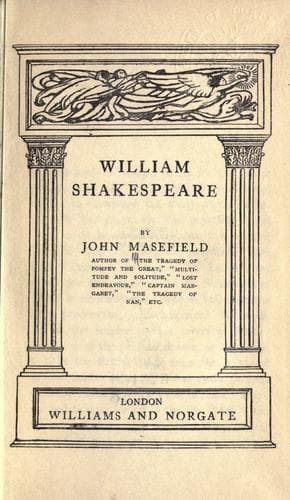
Shakespeare, William, 1564-1616 -- Criticism and interpretation
That working of an invisible judge, which we call Chance, "life's
justicer," lays the villainy bare at the instant of its perfection.
Emilia, Iago's wife, a common nature, with no more intelligence than a
want of illusion, enters a moment too late to stay the slaughter, but
too soon for Iago's purpose. She is the one person in the play certain
to be loyal to Desdemona. She is the one person in the play who, judging
from her feelings, will judge rightly. The finest part of the play is
that scene in which her passionate instinct sees through the web woven
about Othello by an intellect that has put aside all that is passionate
and instinctive.
The influence and importance of the little thing in the great event is
marked in this scene as in half-a-dozen other scenes in the greater
tragedies. We are all or may at any time become immensely important to
the play of the world. Had Emilia come a minute sooner or a minute
later the end of the play would have been very different. Desdemona
would have lived to repent her marriage at leisure, or she would have
gone to her grave branded.
Shakespeare brooded much upon all the tragedies of intellect. In this
play, as in _Richard III_ and _The Merchant of Venice_, he brooded upon
the power of a warped intellect to destroy generous life. When he
created Iago he wrote in a cooler spirit than when he created the
earlier characters. Iago is therefore much more perfectly a living being
but much less passionately alive than the soul burnt out at Bosworth, or
the soul flouted in the Duke's Court. He is drawn with a sharp and wiry
line. Like all sinister men, he tells nothing of himself. We see only
his intellect. What he is in himself is as mysterious as life. Life is
clear, up to a point, but beyond that point it is always baffling.
Shakespeare's task was to look at life clearly. Looking at it clearly he
was as baffled by what he saw, as we, who only see by his aid. He found
in Iago an image like life itself, a power and an activity, prompted by
something secret and silent.
Much ink has been wasted about the "duration of time" in this play. The
action of the play is one. It matters not if the time be divided into
ten or fifty. In London and the University towns where writing is mostly
practised, the play is seldom played. It is almost never played as
Shakespeare meant it to be played. Those who write about it write after
reading it. This is a reading age. Shakespeare's was an active age. That
those who care most for his tragedies should be ignorant of the laws
under which he worked is our misfortune and our fault and our disgrace.
Public-domain text, read in full here on John Shaqi.
Reviews
Reviews
No reviews yet
Be the first to share your thoughts on this work.
Elsewhere in the archive
Join the Discussion
Join the discussion
Sign in to leave a comment or review.
Sign InorCreate an account