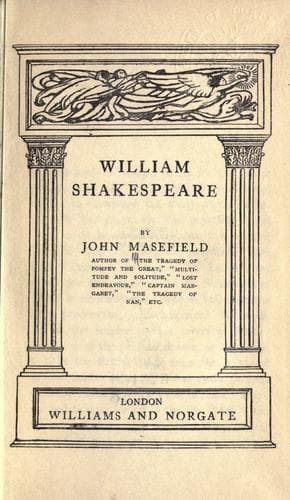
Shakespeare, William, 1564-1616 -- Criticism and interpretation
Coming weary and excited from battle, on a day so strange that it adds
to the strangeness of his mood, Macbeth hears the hags hail him with
prophecy. The promise rankles in him. The seed scattered in us by the
beings outside life comes to good or evil according to the sun in us.
Macbeth, looking on the letter of the prophecy, thinks only of the
letter of its fulfilment, till it becomes an obsession with him.
Partial fulfilment of the prophecy convinces him that all will be
fulfilled. The belief that the veil over the future has been lifted for
him gives him the recklessness of one bound in the knots of fate. So
often, the thought that the soul is in a trap, playing out something
planned of old, makes man take the frantic way, when the smallest belief
in life would lead to peace. This thought passes through his mind. Then
fear that it is all a contriving of the devils makes him put it manfully
from his mind. The talk about the Cawdor whose place he holds is a
thrust to him. That Cawdor was a traitor who has been put to death for
treachery. The king had an "absolute trust" in him; but there is no
judging by appearances. This glimpse of the ugliness of treachery makes
Macbeth for an instant free of all temptation to it. Then a word stabs
him again to the knowledge that if he take no step the king's young son
will be king after Duncan. Why should the boy rule? From this point he
goes forward, full of all the devils of indecision, but inclining
towards righteousness, till his wife, girding and railing at him with
definite aim while all his powers are in mutiny, drives him to the act
of murder.
The story of the double treachery of the killing of a king, who is also
a guest, is so written that we do not feel horror so much as an
unbearable pity for Macbeth's mind. The horror is felt later, when it is
made plain that the treachery does not end with that old man on the bed,
but proceeds in a spreading growth of murder till the man who fought so
knightly at Fife is the haunted awful figure who goes ghastly, killing
men, women and little children, till Scotland is like a grave. At the
end, the "worthy gentleman," "noble Macbeth," having fallen from depth
to depth of degradation, is old, hag-haunted, sick at heart, and weary.
He has no friends. He knows himself silently cursed by every one in his
kingdom. His queen is haunted. There is a curse upon the pair of them.
The birds of murder have come to roost. All that supports him is his
trust in his reading of the words of the hags. He knows himself secure.
"And you all know security
Is mortal's chiefest enemy,"
He has supped full with horrors. His bloody base mind is all a blur with
gore. But he is resolute in evil still. At the end he sees too late that
he has been tricked by--
"the equivocation of the fiend
That lies like truth."
Public-domain text, read in full here on John Shaqi.
Reviews
Reviews
No reviews yet
Be the first to share your thoughts on this work.
Elsewhere in the archive
Join the Discussion
Join the discussion
Sign in to leave a comment or review.
Sign InorCreate an account