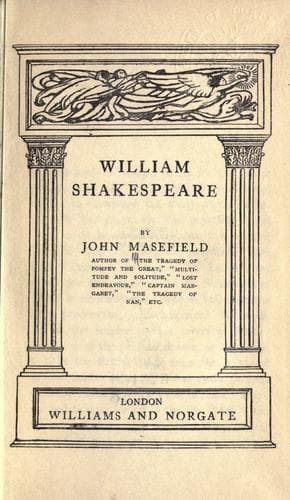
Shakespeare, William, 1564-1616 -- Criticism and interpretation
The acts are opened by rhyming prologues designed to be spoken by John
Gower. The prologues to each of the three first acts are followed by
Dumb Shows, an invention of the theatre to explain those things not
easily to be shown in action. The prologues, the invention of the dumb
shows, and the first two acts, are not by Shakespeare. They are like the
poetical work of George Wilkins, who published a prose romance of _The
Painfull Adventures of Pericles Prince of Tyre_ in the year 1608,
probably after the play had been produced.
The construction of the last three acts makes it likely that the play
(in its original state) was by the constructor of the first two acts. It
is not known how it came to pass that Shakespeare took the play in hand.
From the comparative feebleness of his work upon it, it may be judged
that it was not a labour of love. The impression given is that nothing
in the piece is wrought with more than the mechanical power of the great
mind, that Shakespeare was not deeply interested in the play, but that
he re-wrote the last three acts so that his company might play the piece
and make money by it. The play has often succeeded on the stage, and the
knowledge that it would succeed may have weighed with the manager of a
theatre on which many depended for bread.
There is little that is precious in the play. The scenes in the brothel
at Mitylene (in Act IV) have power. Many find their unpleasantness an
excuse for saying that Shakespeare never wrote them. They are certainly
by Shakespeare. Cant would always persuade itself that the power to see
clearly ought not to be turned upon evil. Those who can read--
_Bawd._ ... they are so pitifully sodden.
_Pandar._ ... The poor Transylvanian is dead, that lay with the
little baggage.
_Boult._ Ay ... she made him roast-meat for worms--
with disgust at Shakespeare's foulness, yet without horror of heart that
the evil still goes on among human beings, must be strangely made. These
scenes, the very vigorous sea scenes, including the account of the storm
at sea, put into the mouth of Marina--
"My father, as nurse said, did never fear,
But cried 'Good seamen!' to the sailors, galling
His kingly hands, haling ropes;
And, clasping to the mast, endured a sea
That almost burst the deck....
Never was waves nor wind more violent:
And from the ladder-tackle washes off
A canvas-climber. 'Ha,' says one, 'wilt out?'
And with a dropping industry they skip
From stem to stern; the boatswain whistles, and
The master calls and trebles their confusion"--
and the scene in which Cerimon, the man withdrawn from the world to
study the bettering of man, revives the body of Thaisa, are the most
lovely things in the play.
_Cymbeline._
_Written._ (?)
_Published_, in the folio, 1623.
Public-domain text, read in full here on John Shaqi.
Reviews
Reviews
No reviews yet
Be the first to share your thoughts on this work.
Elsewhere in the archive
Join the Discussion
Join the discussion
Sign in to leave a comment or review.
Sign InorCreate an account