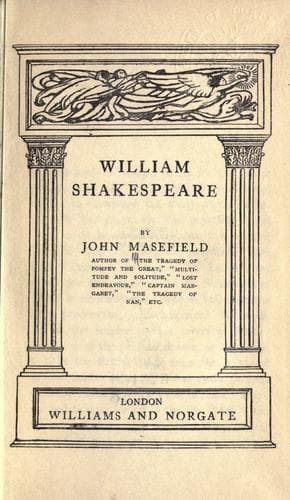
Shakespeare, William, 1564-1616 -- Criticism and interpretation
_The Spanish Tragedy_, a play by Thomas Kyd, published in 1592 and
reprinted with many additions ten years later, contains in the additions
several magnificent scenes of the passion of grief raised to madness.
Some think that Ben Jonson wrote these scenes; others, that they are too
good to be by any one but Shakespeare. They are not like Shakespeare's
work.
_The Two Noble Kinsmen_, a romantic tragedy on the subject of Chaucer's
_Knight's Tale_, was first published in 1634. It was described on the
title-page as the joint work of Fletcher and Shakespeare. Shakespeare's
hand is plainly marked upon the play; but it seems likely that most of
the scenes usually credited to him are by Massinger. Few can have ears
dull enough to credit Shakespeare with all the scenes that are plainly
not by Fletcher.
About a dozen other plays and parts of plays have been attributed to
Shakespeare, either by lying publishers, anxious to make money, or by
foolish critics eager to make a noise. "Evil men understand not
judgment: and he that maketh haste to be rich shall not be innocent."
There is not a glimmer of evidence in any line or scene to show that
Shakespeare had a hand in any of them.
THE POEMS
_Venus and Adonis._--This poem was published in 1593 with a dedication
to the Earl of Southampton, then a youth. In the dedication Shakespeare
speaks of the poem as "the first heire of my invention," from which
some conclude that it was the first poem ever made public by him.
Though it may be his earliest poem, the thought expressed by it is the
thought expressed in the greatest of the plays, that evil comes of
obsession.
Venus, a lustful woman, pursuing her opposite, a chaste youth, comes to
misery. Adonis, a chaste youth, fleeing from her, comes to death.
The poem is beautiful and wild blooded. It is fierce with the excelling
animal zest of something young and untainted.
"The sun ariseth in his majesty
Who doth the world so gloriously behold,
That cedar-tops and hills seem burnish'd gold."
It is full of the images of delicate quick-blooded things going swiftly
and lustily from the boiling of the April in them.
* * * * *
_The Rape of Lucrece._--This poem was published in 1594, with a
dedication to the Earl of Southampton. Like so many of the works of
Shakespeare, it describes at length the prompting, acting, and results
of a treachery inspired by an obsession. Tarquin, hearing of Lucrece's
chastity, longs to attempt her. Coming stealthily to her home, in her
lord's absence, he foully ravishes her. She kills herself and he is
banished from Rome. The subject is not unlike that of _Venus and
Adonis_, with the sexes reversed. In both poems the subject is sexual
obsession and its results.
Public-domain text, read in full here on John Shaqi.
Reviews
Reviews
No reviews yet
Be the first to share your thoughts on this work.
Elsewhere in the archive
Join the Discussion
Join the discussion
Sign in to leave a comment or review.
Sign InorCreate an account