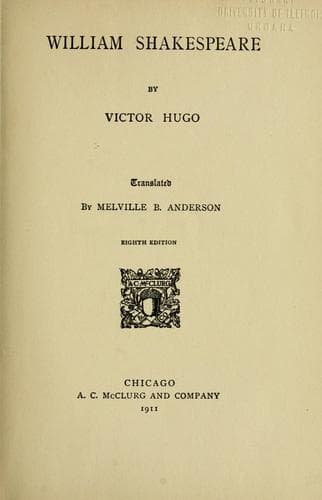
Dramatists, English -- Early modern, 1500-1700 -- Biography; Shakespeare, William, 1564-1616; Stratford-upon-Avon (England) -- Biography
Everything can be written. Paper is patience itself. Last year a grave
review printed this: "Homer is now going out of fashion."
The judgment passed on the philosopher, on the artist, on the poet is
completed by the portrait of the man.
Byron has killed his tailor. Molière has married his own daughter.
Shakespeare has "loved" Lord Southampton.
"Et pour voir à la fin tous les vices ensemble,
Le parterre en tumulte a demandé l'auteur."[5]
That _ensemble_ of all vices is Beaumarchais.
As for Byron, we mention this name a second time; he is worth the
trouble. Read "Glenarvon," and listen, on the subject of Byron's
abominations, to Lady Bl---, whom he had loved, and who, of course,
resented it.
Phidias was a procurer; Socrates was an apostate and a thief,
_décrocheur de manteaux_; Spinosa was a renegade, and sought to
obtain legacies by undue influence; Dante was a peculator; Michael
Angelo was cudgelled by Julius II., and quietly put up with it for
the sake of five hundred crowns; D'Aubigné was a courtier sleeping in
the water-closet of the king, ill-tempered when he was not paid, and
for whom Henri IV. was too kind; Diderot was a libertine; Voltaire a
miser; Milton was venal,--he received a thousand pounds sterling for
his apology, in Latin, of regicide: "Defensio pro se," etc. Who says
these things? Who relates these histories? That good person, your old
fawning friend, O tyrants, your ancient comrade, O traitors, your old
auxiliary, O bigots, your ancient comforter, O imbeciles!--calumny.
[Footnote 1: This coarse flatterer of the vulgar herd.]
[Footnote 2: To me they dare to prefer Crébillon the barbarian.]
[Footnote 3: The passage in Saumaise is curious and worth the trouble
of being transcribed:--
Unus ejus Agamemnon obscuritate superat quantum est
librorum sacrorum cum suis hebraismis et syrianismis et
totâ hellenisticâ supellectile vel farragine.
--_De Re
Hellenisticâ_, p. 38, ep. dedic.]
[Footnote 4: Letter CV.]
[Footnote 5:
"And at last, in order to see all the vices together,
The riotous pit called for the author."
]
CHAPTER II.
Let us add a detail. Diatribe is, on certain occasions, a useful means
of government.
Public-domain text, read in full here on John Shaqi.
Reviews
Reviews
No reviews yet
Be the first to share your thoughts on this work.
Elsewhere in the archive
Join the Discussion
Join the discussion
Sign in to leave a comment or review.
Sign InorCreate an account