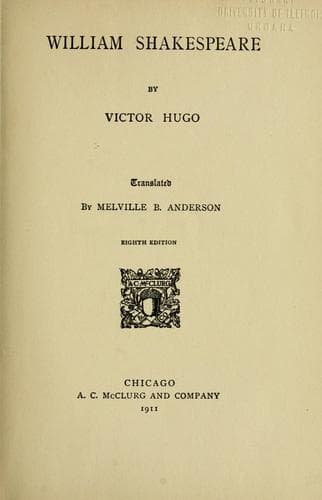
Dramatists, English -- Early modern, 1500-1700 -- Biography; Shakespeare, William, 1564-1616; Stratford-upon-Avon (England) -- Biography
Here three questions: To construct what? To construct where? To
construct how?
We reply: To construct the people. To construct the people according to
the laws of progress. To construct the people according to the laws of
light.
CHAPTER II.
To work for the people,--that is the great and urgent necessity.
The human mind--an important thing to say at this minute--has a greater
need of the ideal even than of the real.
It is by the real that we exist; it is by the ideal that we live. Now,
do you wish to realize the difference? Animals exist, man lives.
To live, is to understand. To live, is to smile at the present, to look
toward posterity over the wall. To live, is to have in one's self a
balance, and to weigh in it the good and the evil. To live, is to have
justice, truth, reason, devotion, probity, sincerity, common-sense,
right, and duty nailed to the heart. To live, is to know what one is
worth, what one can do and should do. Life is conscience. Cato would
not rise before Ptolemy. Cato lived.
Literature is the secretion of civilization, poetry of the ideal. That
is why literature is one of the wants of societies. That is why poetry
is a hunger of the soul. That is why poets are the first instructors
of the people. That is why Shakespeare must be translated in France.
That is why Molière must be translated in England. That is why comments
must be made on them. That is why there must be a vast public literary
domain. That is why all poets, all philosophers, all thinkers, all the
producers of the greatness of the mind must be translated, commented
on, published, printed, reprinted, stereotyped, distributed, explained,
recited, spread abroad, given to all, given cheaply, given at cost
price, given for nothing.
Poetry evolves heroism. M. Royer-Collard, that original and ironical
friend of routine, was, taken all in all, a wise and noble spirit Some
one we know heard him say one day, "Spartacus is a poet."
That wonderful and consoling Ezekiel--the tragic revealer of
progress--has all kinds of singular passages full of a profound
meaning: "The voice said to me: Fill the palm of thy hand with red-hot
coals, and spread them on the city." And elsewhere: "The spirit having
gone into them, everywhere where the spirit went, they went" And again:
"A hand was stretched towards me. It held a roll which was a book. The
voice said to me: Eat this roll. I opened the lips and I ate the book.
And it was sweet in my mouth as honey." To eat the book is a strange
and striking image,--the whole formula of perfectibility, which above
is knowledge, and below, teaching.
We have just said, "Literature is the secretion of civilization." Do
you doubt it? Open the first statistics you come across.
Public-domain text, read in full here on John Shaqi.
Reviews
Reviews
No reviews yet
Be the first to share your thoughts on this work.
Elsewhere in the archive
Join the Discussion
Join the discussion
Sign in to leave a comment or review.
Sign InorCreate an account