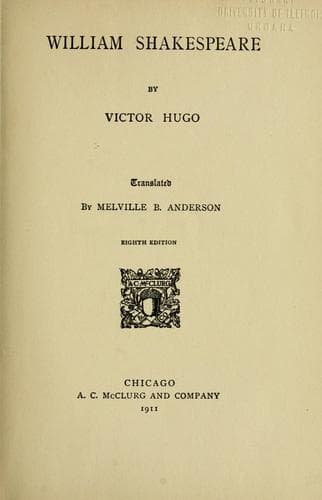
Dramatists, English -- Early modern, 1500-1700 -- Biography; Shakespeare, William, 1564-1616; Stratford-upon-Avon (England) -- Biography
The people have no need of liberty,--such was the pass-word of a
certain innocent and duped school, the head of which has been dead some
years. That poor honest dreamer believed in good faith that men can
keep progress with them when they turn out liberty. We have heard him
put forth, probably without meaning it, this aphorism: Liberty is good
for the rich. These kinds of maxims have the disadvantage of not being
prejudicial to the establishment of empires.
No, no, no! Nothing out of liberty.
Servitude is the blind soul. Can you figure to yourself a man blind
voluntarily? This terrible thing exists. There are willing slaves. A
smile in irons! Can anything be more hideous? He who is not free is not
a man; he who is not free has no sight, no knowledge, no discernment,
no growth, no comprehension, no will, no faith, no love; he has no
wife, he has no children: he has a female and young ones; he lives
not,--_ab luce principium._ Liberty is the apple of the eye. Liberty is
the visual organ of progress.
Because liberty has inconveniences, and even perils, to wish to create
civilization without it is just the same as to try cultivation without
the sun; the sun is also a censurable heavenly body. One day, in the
too beautiful summer of 1829, a critic, now forgotten,--and wrongly,
for he was not without some talent,--M. P., suffering from the heat,
sharpened his pen, saying, "I am going to excoriate the sun."
Certain social theories, very distinct from socialism such as we
understand and want it, have gone astray. Let us discard all that
resembles the convent, the barrack, the cell and the straight-line
system. Paraguay, minus the Jesuits, is Paraguay just the same. To
give a new fashion to evil is not a useful task. To recommence the old
slavery is idiotic. Let the nations of Europe beware of a despotism
made anew from materials they have to some extent themselves supplied.
Such a thing, cemented with a special philosophy, might well last.
We have just mentioned the theorists, some of whom otherwise right
and sincere, who, by dint of fearing the dispersion of activities
and energies, and of what they call "anarchy," have arrived at an
almost Chinese acceptation of absolute social concentration. They turn
their resignation into a doctrine. Provided man eats and drinks, all
is right. The happiness of the beast is the solution. But this is a
happiness which some other men would call by a different name.
Public-domain text, read in full here on John Shaqi.
Reviews
Reviews
No reviews yet
Be the first to share your thoughts on this work.
Elsewhere in the archive
Join the Discussion
Join the discussion
Sign in to leave a comment or review.
Sign InorCreate an account