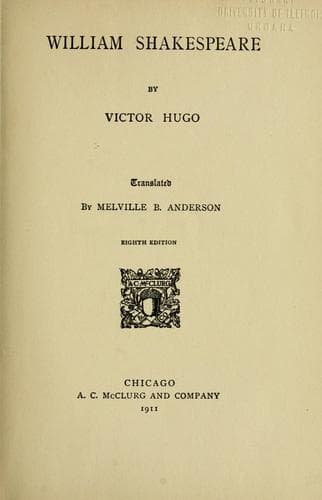
Dramatists, English -- Early modern, 1500-1700 -- Biography; Shakespeare, William, 1564-1616; Stratford-upon-Avon (England) -- Biography
The more we advance North, it seems as if the increased thickness
of the fog increases the greatness of the poet. In Scotland he is
enormous. If anything surpasses the legend of the Rhapsodists, it is
the legend of the Scalds. At the approach of Edward of England, the
bards defend Stirling as the three hundred had defended Sparta; and
they have their Thermopylæ, as great as that of Leonidas. Ossian,
perfectly certain and real, has had a plagiary; that is nothing; but
this plagiarist has done more than rob him,--he has made him insipid.
To know Fingal only by Macpherson is as if one knew Amadis only by
Tressan. They show at Staffa the stone of the poet, _Clachan an
Bairdh_,--so named, according to many antiquaries, long before the
visit of Walter Scott to the Hebrides. This chair of the Bard--a great
hollow rock ready for a giant wishing to sit down--is at the entrance
of the grotto. Around it are the waves and the clouds. Behind the
Clachan an Bairdh is heaped up and raised the superhuman geometry of
basaltic prisms, the pell-mell of colonnades and waves, and all the
mystery of the fearful edifice. The gallery of Fingal runs next to the
poet's chair; the sea beats on it before entering under that terrible
ceiling. When evening comes, one imagines that he sees in that chair
a form leaning on its elbow. "It is the ghost!" say the fishermen of
Mackinnon's clan; and no one would dare, even in full day, to go up as
far as that formidable seat; for to the idea of the stone is allied the
idea of the sepulchre, and on the chair of granite no one can be seated
but the man of shade.
CHAPTER IV.
Thought is power.
All power is duty. Should this power enter into repose in our age?
Should duty shut its eyes? and is the moment come for art to disarm?
Less than ever. The human caravan is, thanks to 1789, arrived on a high
plateau; and the horizon being more vast, art has more to do. This
is all. To every widening of horizon corresponds an enlargement of
conscience.
We have not reached the goal. Concord condensed in happiness,
civilization summed up in harmony,--that is far off yet. In the
eighteenth century that dream was so distant that it seemed a guilty
thought. The Abbé de St. Pierre was expelled from the Academy for
having dreamed that dream,--an expulsion which seems rather severe at a
period when pastorals carried the day, even with Fontenelle, and when
St. Lambert invented the idyll for the use of the nobility. The Abbé
de St. Pierre has left behind him a word and a dream: the word is his
own,--"Benevolence;" the dream belongs to all of us,--"Fraternity."
This dream, which made Cardinal de Polignac foam and Voltaire smile, is
not now so much lost as it was once in the mist of the improbable. It
is a little nearer; but we do not touch it. The people, those orphans
who seek their mother, do not yet hold in their hand the hem of the
robe of peace.
Public-domain text, read in full here on John Shaqi.
Reviews
Reviews
No reviews yet
Be the first to share your thoughts on this work.
Elsewhere in the archive
Join the Discussion
Join the discussion
Sign in to leave a comment or review.
Sign InorCreate an account