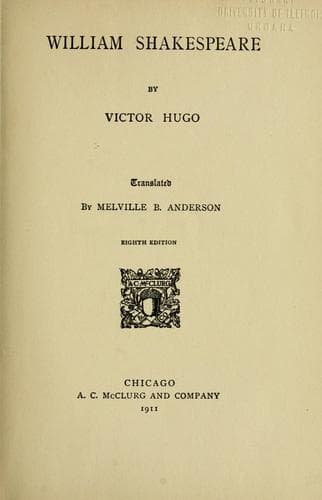
Dramatists, English -- Early modern, 1500-1700 -- Biography; Shakespeare, William, 1564-1616; Stratford-upon-Avon (England) -- Biography
Dead, he no longer obstructs. The hiss, now useless, dies out. Living,
he was a rival; dead, he is a benefactor. He becomes, according to the
beautiful expression of Lebrun "l'homme irréparable." Lebrun observes
this of Montesquieu; Boileau observes the same of Molière. "Avant
qu'un peu de terre" etc. This handful of earth has equally aggrandized
Voltaire. Voltaire, so great in the eighteenth century, is still
greater in the nineteenth. The grave is a crucible. Its earth, thrown
on a man, sifts his reputation, and allows it to pass forth purified.
Voltaire has lost his false glory and retained the true. To lose the
false is to gain. Voltaire is neither a lyric poet, nor a comic poet,
nor a tragic poet: he is the indignant yet tender critic of the old
world; he is the mild reformer of manners; he is the man who softens
men. Voltaire, who has lost ground as a poet, has risen as an apostle.
He has done what is good, rather than what is beautiful. The good being
included in the beautiful, those who, like Dante and Shakespeare,
have produced the beautiful, surpass Voltaire; but below the poet,
the place of the philosopher, is still very high, and Voltaire is the
philosopher. Voltaire is common-sense in a continual stream. Excepting
in literature, he is a good judge in everything. Voltaire was, in spite
of his insulters, almost adored during his lifetime; he is in our days
admired, now that the true facts of the case are known. The eighteenth
century saw his mind: we see his soul. Frederick II., who willingly
railed at him, wrote to D'Alembert, "Voltaire buffoons. This century
resembles the old courts. It has a fool, who is Arouet." This fool of
the century was its sage.
Such are the effects of the tomb for great minds. That mysterious
entrance into the unknown leaves light behind. Their disappearance is
resplendent. Their death evolves authority.
CHAPTER II.
Shakespeare is the great glory of England. England has in politics
Cromwell, in philosophy Bacon, in science Newton,--three lofty men of
genius. But Cromwell is tinged with cruelty and Bacon with meanness; as
to Newton, his edifice is now shaking on its base. Shakespeare is pure,
which Cromwell and Bacon are not, and immovable, which Newton is not.
Moreover, he is higher as a genius. Above Newton there is Copernicus
and Galileo; above Bacon there is Descartes and Kant; above Cromwell
there is Danton and Bonaparte; above Shakespeare there is no one.
Shakespeare has equals, but not a superior. It is a singular honour for
a land to have borne that man. One may say to that land, "Alma parens."
The native town of Shakespeare is an elect place; an eternal light is
on that cradle; Stratford-on-Avon has a certainty that Smyrna, Rhodes,
Colophon, Salamis, Ohio, Argos, and Athens--the seven towns which
disputed the birthplace of Homer--have not.
Public-domain text, read in full here on John Shaqi.
Reviews
Reviews
No reviews yet
Be the first to share your thoughts on this work.
Elsewhere in the archive
Join the Discussion
Join the discussion
Sign in to leave a comment or review.
Sign InorCreate an account