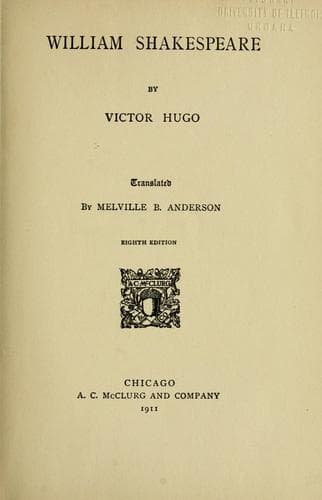
Dramatists, English -- Early modern, 1500-1700 -- Biography; Shakespeare, William, 1564-1616; Stratford-upon-Avon (England) -- Biography
England, mercantile like Carthage, legal like Sparta, is worth more
than Sparta and Carthage. She is honoured by this august exception,--a
poet. To have given birth to Shakespeare makes England great.
Shakespeare's place is among the most sublime in that _élite_ of
absolute men of genius which, from time to time increased by some
splendid fresh arrival, crowns civilization and illumines with its
immense radiancy the human race. Shakespeare is legion. Alone, he forms
the counterpoise to our grand French seventeenth century, and almost to
the eighteenth.
When one arrives in England, the first thing that he looks for is the
statue of Shakespeare. He finds the statue of Wellington.
Wellington is a general who gained a battle, having chance for his
partner.
If you insist on seeing Shakespeare's statue you are taken to a place
called Westminster, where there are kings,--a crowd of kings: there is
also a comer called "Poets' Corner." There, in the shade of four or
five magnificent monuments where some royal nobodies shine in marble
and bronze, is shown to you on a small pedestal a little figure, and
under this little figure, the name, "WILLIAM SHAKESPEARE."
In addition to this, statues everywhere; if you wish for statues you
may find as many as you can wish. Statue for Charles, statue for
Edward, statue for William, statues for three or four Georges, of whom
one was an idiot. Statue of the Duke of Richmond at Huntley; statue
of Napier at Portsmouth; statue of Father Mathew at Cork; statue
of Herbert Ingram, I don't know where. A man has well drilled the
riflemen,--he gets a statue; a man has commanded a manœuvre of the
Horse Guards,--he gets a statue. Another has been a supporter of the
past, has squandered all the wealth of England in paying a coalition
of kings against 1789, against democracy, against light, against the
ascending movement of the human race,--quick! a pedestal for that; a
statue to Mr. Pitt. Another has knowingly fought against truth, in the
hope that it might be vanquished, and has found out one fine morning
that truth is hard-lived, that it is strong, that it might be intrusted
with forming a cabinet, and has then passed abruptly over to its
side,--one more pedestal; a statue for Mr. Peel. Everywhere, in every
street, in every square, at every step, gigantic notes of admiration
in the shape of columns,--a column to the Duke of York, which should
really take the form of points of interrogation; a column to Nelson,
pointed at by the ghost of Caracciolo; a column to Wellington, already
named: columns for everybody. It is sufficient to have played with a
sword somewhere. At Guernsey, by the seaside, on a promontory, there
is a high column, similar to a lighthouse,--almost a tower; this one
is struck by lightning; Æschylus would have contented himself with
it. For whom is this?--for General Doyle. Who is General Doyle?--a
general. What has this general done?--he has constructed roads. At his
Public-domain text, read in full here on John Shaqi.
Reviews
Reviews
No reviews yet
Be the first to share your thoughts on this work.
Elsewhere in the archive
Join the Discussion
Join the discussion
Sign in to leave a comment or review.
Sign InorCreate an account