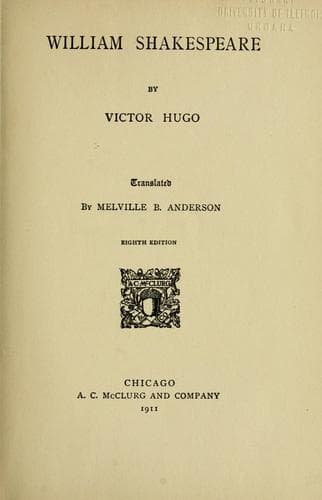
Dramatists, English -- Early modern, 1500-1700 -- Biography; Shakespeare, William, 1564-1616; Stratford-upon-Avon (England) -- Biography
It is not men that are tyrants, but things. The real tyrants are called
frontier, track, routine; blindness under the form of fanaticism,
deafness and dumbness under the form of diversity of languages; quarrel
under the form of diversity of weights, measures, and moneys; hatred
resulting from quarrel, war resulting from hatred. All these tyrants
may be called by one name,--separation. Division, whence proceeds
irresponsible government,--this is despotism in the abstract.
Even the tyrants of flesh are mere things. Caligula is much more a
fact than a man; he is a result more than an existence. The Roman
proscriber, dictator, or Cæsar, refuses the vanquished fire and
water,--that is to say, puts his life out. One day of Gela represents
twenty thousand proscribed, one day of Tiberius thirty thousand, one
day of Sylla seventy thousand. One evening Vitellius, being ill, sees
a house lighted up, where people were rejoicing. "Do they think me
dead?" says Vitellius. It is Junius Blesus who sups with Tuscus Cæcina;
the emperor sends to these drinkers a cup of poison, that they may
realize by this sinister end of too joyous a night that Vitellius is
living. (Reddendam pro intempestiva licentia mœstam et funebrem
noctem qua sentient vivere Vitellius et impresser.) Otho and this same
Vitellius forward assassins to each other. Under the Cæsars, it is a
marvel to die in one's bed; Pison, to Whom this happened, is noted for
that strange incident. The garden of Valerius Asiaticus pleases the
emperor; the face of Stateless displeases the empress,--state crimes:
Valerius is strangled because he has a garden, And Statilius because
he has a face. Basil II., Emperor of the East, makes fifteen thousand
Bulgarians prisoners; they are divided into bands of a hundred, and
their eyes are put out, with the exception of one, who is charged
to conduct his ninety-nine blind comrades. He afterward sends into
Bulgaria the whole of this army without eyes. History thus describes
Basil II.: "He was too fond of glory."[1] Paul of Russia gave out this
axiom: "There is no man powerful save him to whom the emperor speaks;
and his power endures as long as the word that he hears." Philip V.
of Spain, so ferociously calm at the _auto-da-fés_, is frightened at
the idea of changing his shirt, and remains six months in bed without
washing and without trimming his nails, for fear of being poisoned, by
means of scissors, or by the water in the basin, or by his shirt, or by
his shoes. Ivan, grandfather of Paul, had a woman put to the torture
before making her lie in his bed; had a newly married bride hanged,
and placed the husband as sentinel by her side, to prevent the rope
from being cut; had a father killed by his son; invented the process of
sawing men in two with a cord; burns Bariatinski himself by slow fire,
and, while the patient howls, brings the embers together with the end
of his stick. Peter, in point of excellence, aspires to that of the
Public-domain text, read in full here on John Shaqi.
Reviews
Reviews
No reviews yet
Be the first to share your thoughts on this work.
Elsewhere in the archive
Join the Discussion
Join the discussion
Sign in to leave a comment or review.
Sign InorCreate an account