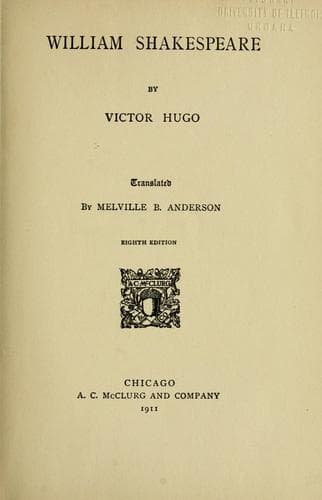
Dramatists, English -- Early modern, 1500-1700 -- Biography; Shakespeare, William, 1564-1616; Stratford-upon-Avon (England) -- Biography
These exchanges of parts will put people in their true light; the
historical optic, renewed, will re-adjust the ensemble of civilization,
at present a chaos; for perspective, that justice of geometry, will
size the past,--making such a plan to advance, placing another in the
background. Every one will assume his real stature; the head-dresses
of tiaras and of crowns will only make dwarfs more ridiculous; stupid
genuflexions will vanish. From these alterations will proceed right.
That great judge We ourselves,--We all,--having henceforth for measure
the clear idea of what is absolute and what is relative, deductions
and restitutions will of themselves take place. The innate moral sense
within man will know its power; it will no longer be obliged to ask
itself questions like this,--Why, at the same minute, do people revere
in Louis XV. and all the rest of royalty the act for which they bum
Deschauffours on the Place de Grève? The quality of kingship will
no longer be a false moral weight. Facts fairly placed will place
conscience fairly. A good light will come, sweet to the human race,
serene, equitable, with no interposition of clouds henceforth between
truth and the brain of man, but a definitive ascent of the good, the
just, and the beautiful toward the zenith of civilization.
Nothing can escape the law which simplifies. By the mere force of
things, the material side of facts and of men disintegrates and
disappears. There is no shadowy solidity; whatever may be the mass,
whatever may be the block, every combination of ashes (and matter is
nothing else) returns to ashes. The idea of the atom of dust is in
the word "granite,"--inevitable pulverizations. All those granites of
oligarchy, aristocracy, and theocracy are doomed to be scattered to the
four winds. The ideal alone is indestructible. Nothing lasts save the
mind.
In this indefinite increase of light which is called civilization, the
processes of reduction and levelling are accomplished. The imperious
morning light penetrates everywhere,--enters as master, and makes
itself obeyed. The light is at work; under the great eye of posterity,
before the blaze of the nineteenth century, simplifications take place,
excrescences fall away, glories drop like leaves, reputations are riven
in pieces. Do you wish for an example,--take Moses. There is in Moses
three glories,--the captain, the legislator, the poet. Of these three
men contained in Moses, where is the captain to-day? In the shadow,
with brigands and murderers. Where is the legislator? Amidst the waste
of dead religions. Where is the poet? By the side of Æschylus.
Daylight has an irresistible corroding power on the things of night.
Hence appears a new historic sky above our heads, a new philosophy of
causes and results, a new aspect of facts.
Public-domain text, read in full here on John Shaqi.
Reviews
Reviews
No reviews yet
Be the first to share your thoughts on this work.
Elsewhere in the archive
Join the Discussion
Join the discussion
Sign in to leave a comment or review.
Sign InorCreate an account