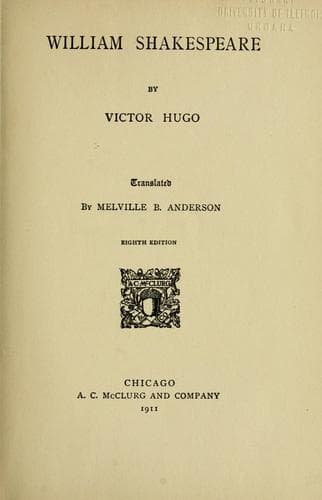
Dramatists, English -- Early modern, 1500-1700 -- Biography; Shakespeare, William, 1564-1616; Stratford-upon-Avon (England) -- Biography
I stopped in thought; then I began to read again. Some moments
afterward I could see nothing, hear nothing; I was immersed in the
poet. At the dinner-hour I made a sign that I was not hungry; and at
night, when the sun set, and when the herds were returning to their
sheds, I was still in the same place reading the wonderful book; and
by my side my father, with his white locks, seated on the door-sill of
the low room, where his sword hung on a nail, indulging my prolonged
reading, was gently calling the sheep; and they came in turn to eat a
little salt in the hollow of his hand.
[Footnote 1:
Nec pietas ulla est, velatum saepe videri
Vertier ad lapidem, atque omnes accedere ad aras.
Nec procumbere humi prostratum, et pandere palmas
Ante deum delubra, neque aras sanguine multo
Spargere quadrupedum, nec votis nectere vota;
Sed mage placata posse omnia mente tueri.
]
CHAPTER V.
Poetry cannot grow less. Why? Because it cannot grow greater.
These words, so often used, even by the lettered, "decline," "revival,"
show to what an extent the essence of art is ignored. Superficial
intellects, easily becoming pedantic, take for revival and decline some
effects of juxtaposition, some optical mirages, some exigencies of
language, some ebb and flow of ideas, all the vast movement of creation
and thought, the result of which is universal art. This movement is the
very work of the infinite passing through the human brain.
Phenomena are only seen from the culminating point; and seen from the
culminating point, poetry is immovable. There is neither rise nor
decline in art. Human genius is always at its full; all the rain of
heaven adds not a drop of water to the ocean. A tide is an illusion;
water falls on one shore only to rise on another. You take oscillations
for diminutions. To say, "There will be no more poets," is to say,
"There will be no more ebbing."
Poetry is element. It is irreducible, incorruptible, and refractory.
Like the sea, it says each time all it has to say; then it re-begins
with a tranquil majesty, and with the inexhaustible variety which
belongs only to unity. This diversity in what seems monotonous is the
marvel of immensity.
Wave upon wave, billow after billow, foam behind foam, movement and
again movement: the Iliad is moving away, the Romancero comes; the
Bible sinks, the Koran surges up; after the aquilon Pindar comes the
hurricane Dante. Does everlasting poetry repeat itself? No. It is the
same and it is different. Same breath, another sound.
Public-domain text, read in full here on John Shaqi.
Reviews
Reviews
No reviews yet
Be the first to share your thoughts on this work.
Join the Discussion
Join the discussion
Sign in to leave a comment or review.
Sign InorCreate an account